
The Moon May Be Older Than We Thought
Engineering360 News Desk | January 13, 2017A research team reports that the moon is at least 4.51 billion years old, or 40 million to 140 million years older than scientists previously thought.
The findings—based on an analysis of minerals from the moon called zircons that were brought back to Earth by the Apollo 14 mission in 1971—were published in the journal Science Advances.
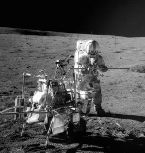 Apollo 14 astronaut Alan Shepard. A new UCLA study determined the age of the moon by analyzing minerals brought back by the 1971 mission.The moon’s age has been a debated topic, even though scientists have tried to settle the question over many years and using a wide range of scientific techniques.
According to Mélanie Barboni, the study’s lead author and a research geochemist in the University of California-Los Angeles' Department of Earth, Planetary and Space Sciences, a minimum age for the moon has been pinned down.
The moon was formed by a head-on collision between the early Earth and a “planetary embryo” called Theia, a UCLA-led team of geochemists and colleagues reported in 2016.
The newest research would mean that the moon formed “only” about 60 million years after the birth of the solar system—an important point because it would provide critical information for astronomers and planetary scientists who seek to understand the early evolution of the Earth and our solar system.
That has been a difficult task, Barboni says, because “whatever was there before the giant impact has been erased.” While scientists cannot know what occurred before the collision with Theia, these findings are important because they will help scientists continue to piece together major events that followed it.
It’s usually difficult to determine the age of moon rocks because most of them contain a patchwork of fragments of multiple other rocks. But Barboni was able to analyze eight zircons in pristine condition.
Specifically, she examined how the uranium they contained had decayed to lead (in a lab at Princeton University) and how the lutetium they contained had decayed to an element called hafnium (using a mass spectrometer at UCLA). The researchers analyzed those elements together to determine the moon’s age.
The Earth’s collision with Theia created a liquefied moon, which then solidified. Scientists believe most of the moon’s surface was covered with magma right after its formation. The uranium–lead measurements reveal when the zircons first appeared in the moon’s initial magma ocean, which later cooled down and formed the moon’s mantle and crust; the lutetium–hafnium measurements reveal when its magma formed, which happened earlier.
Previous studies concluded the moon’s age based on moon rocks that had been contaminated by multiple collisions. Researchers said those rocks indicated the date of some other events, “but not the age of the moon.”
The UCLA researchers are continuing to study zircons brought back by the Apollo astronauts to study the early history of the moon.




OK, that sounds fine and dandy, the moon is confirmed to be old. The earth is confirmed to be old. The solar system is confirmed to be old.
1. Just how old did scientist think the moon was?
2. 1971 Until now to release something the world already knew, as breaking news, seems absurd actually.
3. So in all this cost to investigate the obvious, did anyone actually come up with an idea as to why the moon is there.
4. Zircons seem to be common to earth as well so this may be a business investment to mine the moon now.
Also interesting article on this item.
http://astronomynow.