Low-cost, 3D-printed filter traps microplastics in water
Marie Donlon | October 22, 2026University of Waterloo engineers have developed a customizable 3D-printed water filter that can remove up to 90% of microplastics from contaminated water, potentially offering a new approach to reducing microplastic pollution in drinking water.
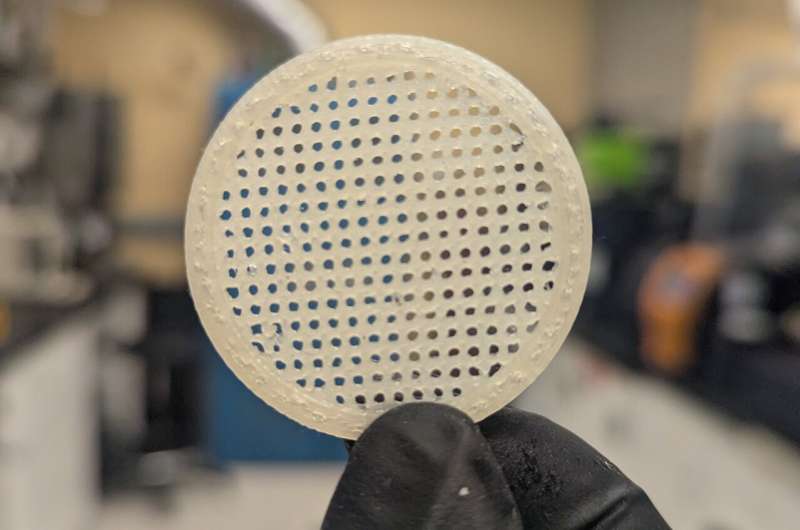
The filter is built from 3D-printed disks of biodegradable polymer, stacked one on top of another, inside a column. Researchers tested columns containing between eight and 20 disks in the lab and found that a 20-disk configuration removed 90% of microplastics.
 Source: University of Waterloo
To create that structure, the team printed each disk with a water-soluble polymer that dissolves out once printing is complete, leaving pores at the nanoscale and microscale, and then added a pressure-sensitive adhesive to the disks.
The filter captures microplastics through a combination of physical filtration and adhesion. As water passes through the filter, the network of nanoscale and microscale pores traps particles that are too large to pass through. At the same time, the pressure-sensitive adhesive on the filter surface helps microplastics stick to the material, improving capture efficiency without blocking the pores.
The filter captured nearly all of the larger microplastic particles, but particles smaller than 10 micrometers were more challenging to remove. Researchers are now refining the design to better capture these smaller particles.
The technology could eventually be incorporated into household drinking water systems and industrial water treatment plants, providing a new option for microplastic filtration.
The research is detailed in the article “3D-printed, flow-through water filters for microplastic capture: The effect of surface porosity, column height, and pressure-sensitive adhesives on removal efficiency,” which appears in the journal Separation and Purification Technology.