"Microbubble Oxygenation" Could Save Lives
John Simpson | December 07, 2016Technology under development by researchers at the University of Nebraska (UN) and the University of Colorado (CU), Boulder could result in the creation of a so-called “third lung” for severely injured patients that could keep them alive until arrival at a hospital. The science involves a new medical treatment, “microbubble oxygenation,” that provides oxygen to those whose lungs cannot function efficiently due to trauma.
By pumping microbubbles into the abdomen while removing dangerous carbon dioxide, the process transmits oxygen to the body's core, which is then circulated to the brain and other vital organs. The treatment could be a lifesaver to lung-damaged soldiers who must sometimes be transported long distances to advanced hospital facilities.
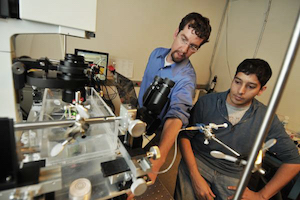 Mark Borden, associate professor of mechanical engineering at CU Boulder (l), and a student work in the laboratory. Image credit: CU Boulder.“I was struggling because it seemed too risky to do a direct intravenous injection of such a large volume of microbubbles," recalls Mark Borden, associate professor of mechanical engineering at CU Boulder. “Ben [Terry, assistant professor of mechanical and materials engineering at UN] brought his expertise in noninvasive surgery, where it is commonplace to inflate the peritoneal cavity to allow space to move the laparoscopic instruments. The peritoneal oxygenation concept was born in this conversation."
The microbubbles are tiny, each one only a fraction of the size of a human hair, and designed to mimic the alveoli in the human lung by releasing oxygen to the body and removing carbon dioxide, says Borden. Each cubic centimeter of microbubble foam contains trillions of individual microbubbles, providing an enormous surface area for the gas exchange process to take place.
“Once the oxygen has been delivered, the spent microbubbles can be safely removed from the peritoneal cavity within the abdomen,” says Borden. “So we do not anticipate any long-term toxicity.”
Going forward, Terry will design and develop a medical device to deliver oxygen microbubbles to patients, while Borden will work on creating both a process and system capable of large-scale manufacturing. Dr. Keely Buesing, assistant professor of surgery at the UN Medical Center, will develop injury models to test the new technique.