Sunscreen Compound Boosts Protection Against UVA Radiation
John Simpson | August 03, 2016A compound developed by University of Bath scientists in collaboration with King’s College London is claimed to offer unprecedented protection against the harmful effects of UVA radiation in sunlight, including photo-aging, cell damage and cancer.
Most sunscreens on the market protect well against solar UVB radiation but have limited effectiveness against UVA-induced damage, relying on the reflective properties of creams to defend against these dangerous rays. The new compound, which the researchers are calling the "mitoiron claw," offers protection within skin cells—where the greatest damage from UVA often occurs—without interfering with the rest of the cell.
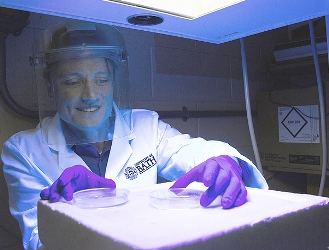 Dr. Olivier Reelfs, from the University of Bath's Department of Pharmacy and Pharmacology, carries out tests with an ultraviolet lamp. Image credit: AP Commercial PhotographyAccording to the researchers, free iron concentration is particularly high within mitochondria, the "batteries" of the cell, where it is needed for several vital functions. However, upon exposure to UVA in sunlight, excess free iron acts as a catalyst to produce toxic reactive oxygen species. These species may damage cell components such as DNA, fat and proteins and thereby increase the risk of cell death and cancer.
The researchers' iron chelator—a molecule that binds to an iron atom like a claw—moves directly to mitochondria, where it binds the excess free iron, preventing it from reacting upon exposure to UVA rays.
Tests with human skin fibroblast cells exposed to UVA radiation equivalent to 140 minutes of uninterrupted sun exposure at sea level showed cells treated with the mitoiron claw were protected against cell death. Untreated cells suffered significant cell death, the researchers say.
In addition to its use as an additive to sunscreens and skin care products, the team sees potential applications in developing therapies for diseases involving mitochondrial iron overload, such as Friedreich's ataxia.