Study on 'Gut Chip' Points Toward Anti-radiation Drugs
Tony Pallone | February 15, 2018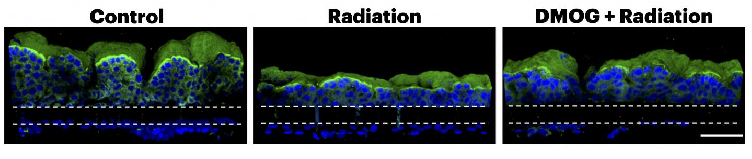 Intestinal epithelium in a human gut-on-a-chip break down with the chip is exposed to radiation, but are protected against damage by DMOG. Source: Wyss Insitute at Harvard University.
Developing drugs to protect against the harmful effects of radiation has been a goal of scientists for some time. While the total number of people affected by nuclear incidents like those at Three Mile Island, Chernobyl and Fukushima is small, millions of cancer patients around the world receive radiation therapy annually. And while they are exposed to lower doses of radiation, they can still suffer from harmful, cumulative side effects.
What makes drug development difficult in this area is the fact that exposing healthy people to radiation for clinical trials would be unethical — and the alternative approach of using animal studies has proven to be a poor predictor of how a given drug will behave in humans.
But researchers from the Wyss Institute for Biologically Inspired Engineering at Harvard University, Instituto Superior Técnico (IST, Portugal), Boston Children's Hospital and Harvard Medical School (HMS) have published a study using an organ-on-a-chip model of the human gut that reveals the intestinal blood vessel cells may play an important part in radiation-induced intestinal injury. The study also confirms that a potential radioprotective drug, dimethyloxaloylglycine (DMOG), suppresses the intestine's responses to radiation injury.
The Gut Chip used by the researchers is a microfluidic device composed of a clear, flexible polymer containing two parallel microchannels separated by a porous extracellular matrix membrane. One channel is coated with human intestinal epithelial cells, the other with human endothelial cells that mimic the blood vessel wall. In order to mimic the peristalsis-like motions that move food through the intestine, cell culture medium is perfused through both channels, and suction is applied to side chambers within the chip at regular intervals. Under these conditions, the epithelial cells spontaneously form intestinal villus-like structures and surface microvilli that increase the cells' surface area for nutrient exchange — much as they do in living intestine.
When the researchers exposed the Gut Chip to a radiation dose of 8 Gray, which is known to cause gastrointestinal effects in humans, they observed increases in several markers of cell damage — apoptosis (cell death), generation of reactive oxygen species (ROS, or free radicals), double-stranded DNA breaks, degradation of lipids in the cell membrane and loss of microvilli structure. There was also disruption of the junctions between neighboring cells and of the mucous membrane that protects the intestinal wall from bacteria and toxins.
The team then exposed the Gut Chip to DMOG, a compound that has been shown to prevent radiation injury in rats by increasing the protective protein production, prior to administering radiation. They observed that DMOG pre-treatment significantly reduced apoptosis, ROS generation and lipid degradation, intestinal permeability and microvillus injury of intestinal epithelial cells — a result that has never been demonstrated in human tissues before.
While this study used a line of infinitely-replicating Caco-2 human intestine cells, a newer iteration of the Gut Chip uses primary human intestinal cells taken directly from patients.
"The grand vision for the future of this technology is to link different Organ Chips into a fully personalized body-on-chips model, where we'd be able to take cells from a patient and test which medicines will best protect all their organs from radiation, either higher doses from nuclear events or lower doses from off-target cancer treatment," said Oren Levy, co-author of the paper and a staff scientist at the Wyss Institute.
The research was funded by the U.S. Food and Drug Administration (FDA). The study appears in the journal Cell Death & Disease.
Source: Wyss Insitute at Harvard University.