New Battery Outperforms Li-ions in Half the Space
Riia O'Donnell | August 02, 2016Researchers at the Massachusetts Institute of Technology have developed a concept for lithium-oxygen batteries that could provide a higher level of stability and discharge more energy for their weight.
The nanolithia cathode battery uses nanometer-scale particles of lithium and oxygen compounds. These are embedded into a lattice of cobalt oxide that has a sponge-like quality. The lattice keeps the particles stable and overcomes problems often seen in lithium-ion batteries, such as fast degradation and energy waste due to heat.
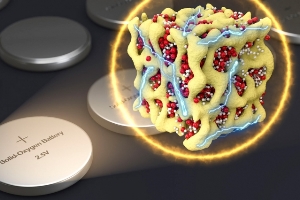 Nanolithia embedded in a cobalt oxide matrix. Image credit: Ju Li and Zhi Zhu, MITThe new battery could be packaged similarly to current fully sealed batteries and may reduce the waste incurred in recharging. The voltage loss in recharging falls by a factor of five, the researchers say, from 1.2 volts to 0.24 volts. That means 8% of the electrical energy is turned to heat.
Traditional lithium-ion batteries draw and release external air during their charging and discharging cycles. The new batteries use the same process, but without letting the oxygen revert to a gaseous form. The oxygen stays inside the solid, transforming between its three redox states, and mixed in glass form. The battery is expected to provide faster charging, fewer heat safety concerns and added efficiency, the MIT team says.
In addition, bypassing the oxygen conversion from gaseous to solid states reduces volume changes that can damage electrical conduction paths and limit its longevity.
By using nanometer scale particles containing lithium and the oxygen in the form of a glass, or nanolithia, the transitions occur completely within the solid material, the researchers say. Stabilizing them within a matrix of cobalt oxide protects the particles and acts as a catalyst for transformations.
At 120 charge/discharge cycles the battery lost less than 2% of its capacity. Researchers say that it is lighter than conventional lithium-ion batteries and could store twice the amount of energy in the same storage size.