Nanoantennas for Ultradense Data Recording
Riia O’Donnell | May 09, 2016A team from St. Petersburg’s ITMO University, the Saint Petersburg Academic University and the Joint Institute for High Temperatures in Moscow has collaborated on an approach to manipulate light at the nanoscale level, with hybrid metal-dielectric nanoantennas.
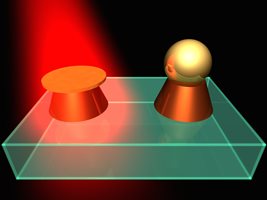 Scientists use selective laser exposure to create hybrid nanoantennas. Image source: ITMO UniversityThe technology could be used to develop a platform for ultradense optical data recording, as well as to create a variety of optical nanodevices that can localize, enhance and manipulate light at the nanoscale.
The current process for creating the planar arrays needed to affect light manipulation with nanomaterials can be a difficult process. The ITMO team has found a way to use two existing production methods: lithography and precise exposure of the nanoantenna to a femtosecond laser, or ultrashort impulse laser, to simplify the process.
To date, modern optical devices record at 10 Gbit/inch2. While these dimensions are similar to the Russian nanoantennas, the scientists propose controlling color in the visible spectrum, adding another dimension for data recording. This approach would result in immediately increasing the data storage capacity of the system, they say.
The nanoantennas are made of a truncated silicon cone with a thin disk on top. With the ability to use nanoscale laser reshaping, the researchers can modify the shape of the disk with no effect to the silicon cone. By altering the shape, the optical properties of the nanoantenna change because of the different degrees of resonance that overlap between the silicon and golden nanoparticles. The method allows the researchers to adjust individual nanoantennas within the array, and allows control over the optical properties of the structures.