'Nanobulb' Shines for Cheaper, Faster Microscopy
Tony Pallone | January 26, 2018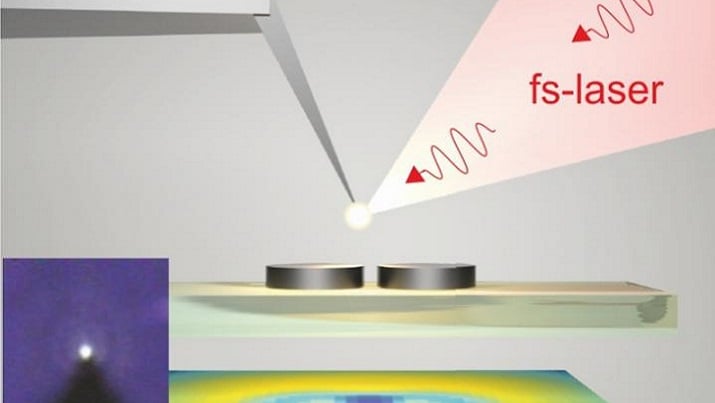 Source: Makarov, Sinev et al.In order to examine an object with an optical microscope, visual light is focused into a lens. But if the object is less than a wavelength in size, it cannot be observed in detail. This is known as the “diffraction limit” -- and while it can be overcome by technology such as near-field optical microscopy, researchers can spend hours scanning at different wavelengths in order to cover the whole spectrum.
But researchers from ITMO University, one of Russia's National Research Universities, have developed a solution for this problem with a “nanobulb" -- a miniature light source based on a nanoparticle made from silicon and gold. It emits light in an immensely wide wavelength band, from 400 to 1,000 nanometers, and can register and analyze the optical response of multiple subwavelength nanostructures in the visible spectrum simultaneously. This greatly increases the efficiency and speed of microscopy.
To create their nanobulb, the scientists first printed a silicon-and-gold nanoparticle, then lit it with a femtosecond infrared laser to make it emit light in the form of photons. Electrons agitated by the laser first attain higher energy levels before sliding towards the bottom of silicon's conduction band, emitting photons on different wavelengths.
What’s interesting about the approach is that the scientists exploited one of silicon’s drawbacks as a material for generating emission – when lit with a laser, it tends to absorb perhaps a million photons and emit just one. But this makes it possible to create a nanosize source of white light, according to Sergei Makarov, senior research at the university’s Department of Nanophotonics and Metamaterials.
Moreover, interfaces at the boundary of silicon and gold provide for an even better radiative recombination of electrons. “Lots of physical mechanisms that we are yet to research are at work here, so there's a lot of theoretical work that we will have to do to improve our nanobulb, including creating an emittance model," adds Ivan Sinev, PhD student at ITMO.
Yet already the researchers have integrated their nanobulb into standard microscopic equipment, allowing for cheaper and more flexible microscopy. Sinev adds that the team is also developing an idea of using the nanobulb as a tunable nanolaser, which would function at any set wavelength in the visible spectrum. “The nanobulb may also see use in biology for purposes such as ‘illuminating’ cells and detecting substances that are sensitive to particular wavelengths," he said.
The study has recently been published in the journal Nano Letters.