Nanodiamonds Turn into a Controllable Light Source with a Higher Purcell Factor
Engineering360 News Desk | May 02, 2018Researchers from ITMO University have developed the first nanodiamond-based light source. The diamond shell doubles emission speed light sources and controls them without nano and microstructures. The team did this by creating artificial defects in the diamond crystal lattice. This is a big development in quantum computers.
Modern nanophotonics requires active dielectric nanoantennas or controlled photonic sources. Nanoantenna scientists typically use plasmonic metal nanoparticles. These particles are problematic for scientists because of optical loss and heating. Scientists have been searching for alternatives for these nanoparticles.
ITMO University researchers are actively developing dielectric nano-photonics. They created nano-antennas that are based on perovskites and silicon. Most recently, researchers from the International Laboratory for Nano-photonics and Metamaterials of ITMO University have developed a new concept of active dielectric nano-antennas that are based on nanodiamonds.
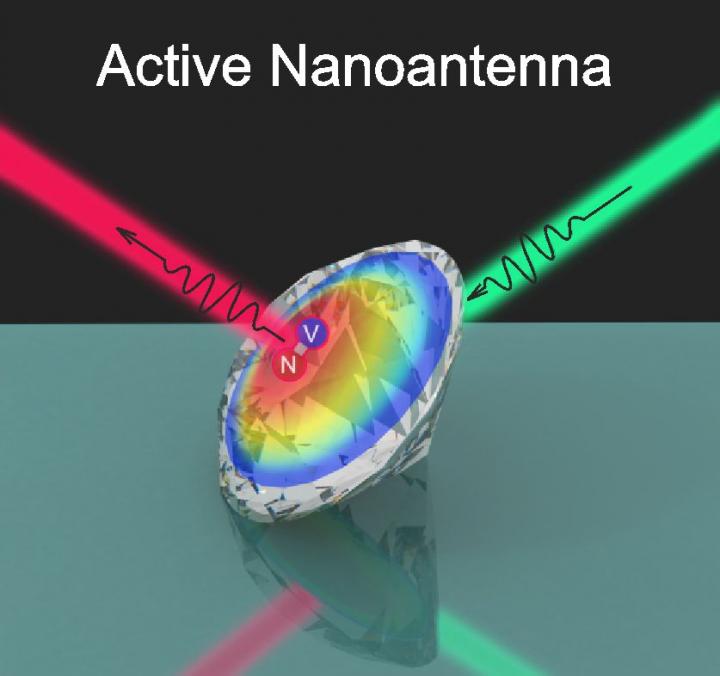 The scheme of obtained active nanodiamond antenna. Source: ITMO University
Nanodiamonds are made of carbon, have a high refractive index, high thermal conductivity and low interaction activity. The researchers used them with so-called nitrogen-vacancy centers (NV centers). Nanodiamonds are created by removing carbon atoms from the diamond crystal lattice. The opened vacancy is then linked to an implanted nitrogen atom. The electron spin of the NV-center is easily controlled by light. This means that researchers were able to use the electron spin to record quantum information.
The researchers studied optical properties of nanodiamonds. They found that the radiation can be enhanced through combinations of the NV-center luminescence spectrum with optical Mie resonance of diamond nanoparticles. This is accomplished through specific positions of the NV-center and particle size. This increases the Purcell factor. This factor is used to estimate how diamond shell affects the rate of spontaneous emission of the light source. With an increased Purcell the luminescence fading time is reduced and the signal becomes stronger.
"Usually, to accelerate the radiation, one has to create a complex system of resonators. But we managed to achieve similar results without any additional structures. We showed experimentally that the luminescence fading can be speeded up at least two times, using just simple physics," said Dmitry Zuev from The International Laboratory for Nanophotonics and Metamaterials.
"Today getting a single photon from one NV-center in a nanoantenna is a rather difficult task. In order to implement such active nanoantenna in logic elements, for example, you need to manage their emission. In perspective, our concept will help to effectively manage single photon emission sources. It is very important for the development of quantum computers and optical communication networks," noted Anastasia Zalogina, lead author of the article, a member of the International Laboratory for Nanophotonics and metamaterials."
The paper on this research was published in the journal Nanoscale.