Detecting Indoor Pollutants at the ppb Level
Engineering360 News Desk | April 25, 2016Volatile organic compounds (VOCs) and other indoor air pollutants thought to be responsible for various health problems, including sick building syndrome, can now be detected down to the parts per billion (ppb) level. Such concentrations are difficult to detect with available environmental sensor technology, which measures at the parts-per-million level.
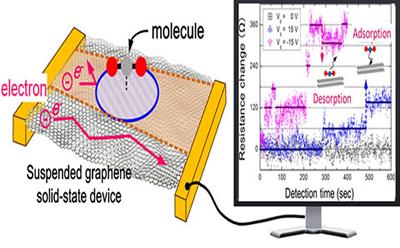 Graphene sensor detecting single CO2 molecule. Image credit: University of Southampton The graphene-based sensor and switch developed by researchers from University of Southampton and the Japan Advanced Institute of Science and Technology detects individual VOC and carbon dioxide molecules emitted by furniture, household goods, and building materials. An electric field applied across the structure enables the device to detect molecules adsorbed onto suspended graphene.
Analysis of the electrical resistance of the graphite beam demonstrated that adsorption/desorption processes of CO2 molecules were recorded as quantized, or incremental, changes in resistance. Only a few minutes were needed to detect a volume of CO2 gas equivalent to about 30 ppb, researchers say.
The researchers plan to combine this highly-sensitive device with graphene-based switches using a uniquely thin film also developed at the University of Southampton. Using the low-voltage switches with the sensor should yield ultra-low-power environmental sensor equipment that can detect single molecules.