How data center power demand is reaching LNG markets
Tyler Gleckler | September 02, 2026 AI-driven data center growth is a credible upside risk for LNG, not a stand-alone driver of LNG demand. Source: Pline/CC-BY-SA-2.5,2.0,1.0
Global liquified natural gas, or LNG, trade and AI-driven power demand now meet in market forecasts, but they are not the same phenomenon. Some LNG suppliers now treat AI and data-center power needs, along with Asian fuel demand and European gas requirements, as factors that could turn an expected LNG oversupply into a shortage by 2030. This view links digital infrastructure to traded gas, but it does not prove that data centers caused today’s LNG demand growth.
Trade data supports a high-volume LNG framing as global LNG imports reached 428 million metric tons in 2025, up 5%, with trade up 22 million metric tons. Global LNG trade totaled 411.24 million metric tons in 2024, marking a new high, according to the latest industry data. The same 2025 figures show Europe up 28 million metric tons and Asia down 11 million metric tons, a pattern that points to shifts in supply security, prices, and regional procurement. The question now is whether data-center load adds an incremental call on gas and LNG, and under what conditions.
Why data centers create a firm-power problem
The first link in the chain is electricity, not LNG. Global data center electricity consumption is projected to rise from 485 TWh in 2025 to 950 TWh in 2030, or about 3% of global electricity demand. AI-focused data-center electricity use is growing faster than the broader category and is projected to triple by 2030, and those figures are large enough to change planning assumptions in specific grid regions.
The U.S. case clearly shows why planners have moved from energy forecasts to reliability questions. U.S. data centers consumed 176 TWh in 2023, accounting for 4.4% of U.S. electricity, and could consume 325 TWh to 580 TWh by 2028. In the PJM Interconnection region, the latest long-term load forecast reflects closer vetting of data center and large-load requests, which is significant because a connection request is not the same as operating load.
Large data centers combine high availability requirements, high load factors, and short service timelines. Utilities must serve annual energy demand (measured in MWh) and capacity and deliverability (measured in MW) at the right location during system stress. Grid connection, equipment availability, and power-supply timing are already constraints, and that is where the LNG story begins to shift toward gas-fired power rather than direct LNG consumption by data centers.
Where gas enters the electricity stack
Gas becomes relevant when load arrives faster than new transmission, renewable generation, storage, or nuclear capacity can connect. In a short-term case built around faster growth in data-center-heavy regions, analysts held generating capacity at the baseline forecast and found that incremental demand would come mainly from higher utilization of existing natural gas-fired plants. Under that higher-demand case, U.S. natural gas generation rises 123 billion kWh from 2025 to 2027, compared with 29 billion kWh in the baseline case.
That is the strongest near-term U.S. causal evidence: AI load can raise domestic gas burn when the system lacks sufficient new capacity to meet demand otherwise. The mechanism does not require data centers to buy LNG or burn LNG onsite because when the marginal power plant runs on gas, data-center load can increase gas consumption, delivered gas costs, and wholesale power prices. In the United States, that means domestic pipeline gas first.
Gas remains only one part of the data-center power mix. Electricity generation serving data centers is estimated to rise from 460 TWh in 2024 to more than 1,000 TWh in 2030. The current physical mix is about 30% coal, 27% renewables, 26% gas, and 15% nuclear. By 2030, renewables will meet nearly half of the added data-center electricity demand, while natural gas and coal together will meet more than 40%. The gas-only version of the story fails, but fossil generation remains part of the reliability and timing response.
Crucially, the U.S. leans more heavily on gas than the global average. Gas supplies more than 40% of U.S. data center electricity today and adds more than 130 TWh of annual generation to serve data centers through 2030. Renewables add about 110 TWh over the same period, while low-carbon procurement and gas-fired reliability support can sit in the same market, even when they pull investment in different directions.
When gas-fired power becomes LNG demand
LNG enters only after another step in the chain; AI and data-center growth increase firm electricity demand. Grid constraints and interconnection delays raise the value of dispatchable generation. Gas-fired plants supply part of that need. Gas demand rises. LNG demand rises only where the marginal gas supply comes from LNG imports, where LNG contracts support incremental gas-to-power demand, or where global price signals and offtake decisions reflect expectations of higher power-sector gas use.
That distinction is most important in the United States. Data-center load can increase domestic gas-fired generation, but U.S. LNG exports depend on liquefaction capacity, pipeline deliverability to terminals, feedgas prices, destination-market demand, and contract structures. The United States can add AI load and LNG export capacity simultaneously, but the causal link still runs through domestic gas balances and international netbacks. Co-located generation does not remove the reliability question either. Rules for AI-driven data centers and other large loads co-located with generation now have to address behind-the-meter generation and transmission service.
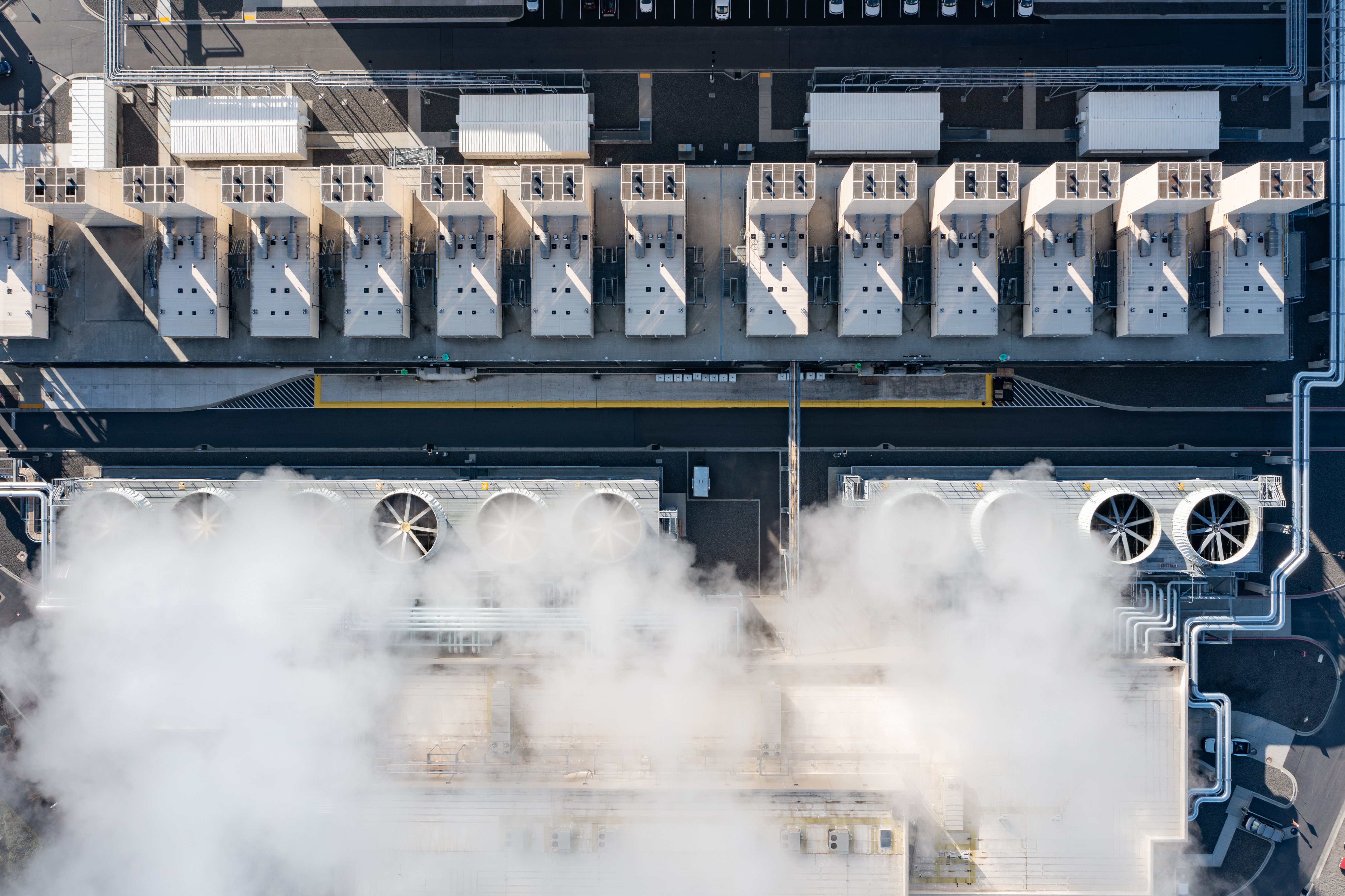 Large data centers combine high availability requirements, high load factors, and short service timelines. Source: Hrach/Adobe stock
The LNG link grows stronger in import-dependent power systems because in LNG-importing markets such as Japan and Korea, incremental gas-to-power demand can translate more directly into cargo needs, term contracting, or higher terminal utilization. The regional data-center power outlook shows why the link varies: Europe’s data-center electricity supply is expected to rely much more on renewables and nuclear, while China, India, and Southeast Asia face different balances among coal, renewables, gas infrastructure, and price sensitivity. The same MW of data-center load can therefore produce LNG demand in one market, domestic gas burn in another, and non-gas investment in a third.
Limits and uncertainty
Several constraints limit how far the AI-to-LNG argument can go. Slow grid connections can strengthen the case for gas in the near term, but gas turbines, pipelines, permits, and interconnection studies also face lead-time constraints. On-site gas serving data centers could reach 15 GW to 27 GW by 2030, but reliable on-site gas-fired electricity may require 30% to 70% overbuild relative to demand and face a gas-turbine supply crunch. Backup capacity can become expensive once redundancy, fuel supply, and equipment lead times are factored into the design.
Low-carbon supply also weakens the assumption that data-center growth must become LNG growth. Renewables are projected to be the largest source of incremental global data-center electricity through 2030. Small modular reactors may become relevant later, but their greater contribution is expected mainly after 2030. Efficiency also matters greatly; energy use per AI task has declined sharply, even as more energy-intensive AI applications grow. Faster chips, fuller server utilization, and better cooling will not erase load growth, but they can change how much new generation the sector actually needs.
The LNG market balance provides a harder counterweight, as roughly 300 billion cubic meters (bcm) per year of new LNG liquefaction capacity is expected by 2030, with the United States and Qatar accounting for about 70% of that volume. In the base case, global LNG demand growth does not absorb all incremental supply, leaving about 65 bcm of surplus supply. Lower prices could stimulate demand in Asia, but infrastructure constraints, contract terms, and weaker macroeconomic conditions could limit the response.
The takeaway for LNG markets
AI-driven data-center growth is a credible upside risk for LNG, not a stand-alone driver of LNG demand. The chain holds where large, fast data-center loads require firm capacity, gas-fired generation supplies the marginal reliability resource, and the gas system depends on LNG imports. It weakens where data centers draw from domestic pipeline gas, where low-carbon supply dominates incremental generation, or where LNG price sensitivity limits fuel switching. Current LNG trade has reached record scale for reasons broader than AI, but digital load growth adds a new variable to gas and LNG balances, although it does not replace the older drivers: power-sector demand, fuel switching, infrastructure, contracts, and price. Data centers generally do not burn LNG directly, but they are still putting more stress on power systems that decide whether digital growth becomes gas demand and, in the right markets, LNG demand.