
Are small modular reactors the future, even as old nuclear plants restart?
Kevin J. Harrigan | October 03, 2026 The cooling towers of Three Mile Island Nuclear Generation Station, pictured here, will reawaken amid plans to recomission three dormant nuclear plants around the U.S. The facility is now called Crane Clean Energy Center. Source: Rowens Photography via Flickr/CC BY-ND 2.0
Nuclear energy generation is finally growing in the United States again. To meet the AI-age’s data center boom, nuclear has become a popular answer for its electricity demands, especially in regions where generation infrastructure exists but lies dormant.
So far, utilities, big tech and energy officials have looked to mothballed nuclear energy facilities, rather than new construction. However, that seems almost certain to be an interim fix, especially when considering the longer-term plans for data center siting.
As a result, it opens the door to exciting, alternative nuclear generation technologies.
Nuclear plants are expensive…
In recent years, energy officials have announced plans to restart three shuttered nuclear power plants, all hailing from the 1970s. These plants, Palisades, Three Mile Island Unit 1 and Duane Arnold, were shut for largely business reasons: operators deemed new generation more economical than refurbishment.
Amid the nuclear ambitions of the 1960s, utilities across the U.S. overzealously invested in nuclear generation, as power demand grew by about 7% a year, according to research. That growth didn’t last through the 1970s, despite the oil crisis, and increasing construction costs meant about half of reactors ordered were eventually canceled.
Nuclear energy is famously expensive. The annual Levelized Cost of Energy Analysis, issued by Lazards, an industrial and energy investment bank, regularly estimates nuclear energy as the second most expensive type of generation, on a dollars-per-megawatt hour basis.
Additionally, even once a nuclear plant is built, its operating costs are high. And it must be regularly updated as new engineering concepts emerge. These costs eventually show up for ratepayers in their monthly bill, which has traditionally hurt nuclear energy’s reputation.
…and often safe
The infamous Three Mile Island in Pennsylvania is one of those plants slated to reopen. In March 1979, a combination of equipment failure, design flaws and operator error led to a partial meltdown of reactor two. Over the next five days, an estimated 100,000 confused residents fled from nearby towns as federal regulators, state politicians and company officials publicly contradicted each other through the news media.
In the end, there were zero casualties and negligible radiation exposure. The scientific consensus is that there was no increased incidence of cancer among the local population. (That is a disputed finding, however.)
Notably, reactor one operated safely for about 39 years, after some of its systems were redesigned following reactor two's meltdown. The Nuclear Regulatory Commission (NRC) ordered changes at power plants with a similar design across the country.
The Three Mile Island mishap was a defining event that damaged American public opinion on nuclear energy safety. That opinion was galvanized seven years later by Chernobyl and is evident in research.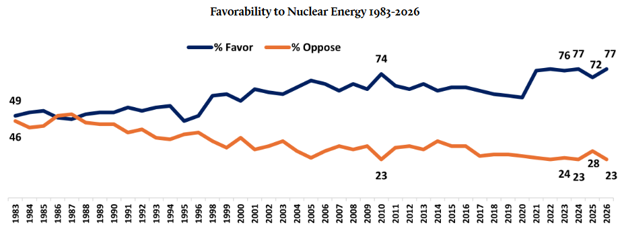 Graph representing U.S. public opinion on nuclear energy since 1983. Source: Bisconti Research Inc
Over the last 43 years, Bisconti Research Inc. has asked U.S. adults, “Do you strongly favor, somewhat favor, somewhat oppose or strongly oppose nuclear power to meet electricity needs?” Bisconti Research is a nuclear energy public opinion research organization led by Ann Stouffer Bisconti.
At no point was nuclear energy less popular than in the 1980s.
However, in more recent decades positive opinion has surged, with 77% in favor as of 2026. This is a significant reversal since the mid-1980s.
Bisconti’s other research shows that the three most important factors for energy utility customers are affordability, reliability and effect on air quality.
Overall, poor business practices, plus concerning safety events, ultimately created an implicit hiatus on new nuclear generation construction in the U.S. that lasted for more than four decades.
Are new plants the answer?
In 2023, Vogtle Electric Generating Plant in Georgia activated the first of two new reactors, the first U.S. reactors approved for construction since 1978.
Reactor manufacturer Westinghouse claimed these new units’ estimated core damage frequency, about 5 in 10 million reactor years, is 200 times safer than the NRC’s guideline. However, nuclear safety has not been the critical issue for Georgian utility payers.
Instead, it is the massive rate hikes they experienced as the utility passed along exorbitant construction costs to utility payers. That has soured many Georgians’ opinion of nuclear energy.
One alternative to new plant-sized reactors could be small modular reactors (SMRs) or microreactors. Bisconti’s research shows while only about one-quarter of U.S. adults know what they are, those who do see them as favorable, with advanced safety features, clean operation and cost effectiveness.
Overall, SMRs are highly modular. They are constructed in a factory and delivered to the generation site by truck. They can be replaced or relocated just as easily. SMRs have a high safety factor, with new passive cooling and automation fail-safes if conditions become risky. They are sited closer to consumers, reducing electrical infrastructure needs. And they are cheaper to scale, allowing utilities and operators to incrementally grow generating capacity with smaller investments.
For these reasons, deployment more closely resembles renewable generation and storage sites than a traditional nuclear facility with looming cooling towers.  James Walker, CEO, Nano Nuclear
“Instead of thinking about nuclear exclusively as a massive power station serving millions of people, we're increasingly discussing applications that include campuses, industrial facilities, military installations, data centers and remote communities,” said James Walker, CEO of Nano Nuclear Energy.
Nano Nuclear is one of those companies innovating in the SMR industry. The company has designs in review with the NRC, as well as a planned reactor research project with the University of Illinois. Walker has previously worked as a nuclear physicist on nuclear submarines with the U.K. defense industry. Indeed, many SMRs take design cues from submarine reactors, even though the uranium sources are different.
“Some regions will continue relying heavily on large centralized generation assets, others will increasingly adopt distributed energy systems, microgrids, energy storage, local generation, and hybrid configurations," he added.
"The common theme is flexibility.”
Full steam ahead on decentralized nuclear
It isn’t just Nano Nuclear and other SMR disruptors experimenting with decentralized nuclear generation. The U.S. Navy is planning to test an unconventional power architecture later in 2026. The flagship USS Gerald R. Ford aircraft carrier will dock at Naval Station Norfolk in Virginia, and its electrical infrastructure will be temporarily integrated with the base to supply electrical power. This is part of a wider military initiative to increase base and asset integration and modularity.
This test is anything but straightforward. The carrier uses a highly enriched uranium fuel that is the power source for everything aboard, from ship screw torque to aircraft launches and ship combat systems, not to forget crew quarters and habitability.
The Navy has yet to confirm when this experiment will take place, at least in part to keep operational secrecy about its prized ship. There is also extensive engineering work that must take place ahead of time.
“Engineers need to ensure the power being supplied matches grid requirements in real time while avoiding disruptions that could affect surrounding infrastructure. There are also questions around power conditioning, synchronization equipment, fault protection, control systems, redundancy, and how the reactor responds to sudden changes in demand,” said Walker.
"Voltage levels, frequency control, load-following requirements, protection systems, grid synchronization, cybersecurity, and operational protocols all have to be addressed before power can be exported reliably and safely,” said Walker.
His perspective is unique due to his dual defense and decentralized energy experience. And he keeps tabs on the industry at large to help steer Nano Nuclear forward.
“Every successful demonstration of distributed nuclear power helps build confidence that nuclear energy can operate in more flexible ways,” he said.
Conclusion
There are multiple nuclear firsts on the near horizon. The official restart of a previously decommissioned nuclear plant has never been done. Safety has been a clear priority.
“The three U.S. nuclear power plants attempting to return to operational status face two sets of hurdles,” said Scott Burnell, senior public affairs officer for the NRC.
“The first involves seeking an exemption from NRC rules so that the company owning the plant can withdraw certain legally binding pledges that were made to permanently defuel the reactor and never operate it again.
“The second hurdle is providing evidence that the plant’s safety systems, as well as its security and emergency preparedness plans, have been restored to a state where they meet the same NRC requirements as currently operating reactors,” he added.
SMRs are new terrain for the NRC as well — just last month it approved construction of the first commercial SMR. SMRs have been influenced by years of safety innovation that had little use, with so few new reactors built.
“Modern reactor developers design systems that are simpler, more passive, and more resilient,” Walker said.
“Many advanced reactor concepts rely on inherent physics rather than active intervention to maintain safe operating conditions. The industry has also benefited from decades of operating experience, improvements in materials science, digital controls, simulation tools, and regulatory oversight.”
SMRs will only earn public trust after years of safe operation. But they can earn buy-in faster, from operators and energy buyers alike, if they can reliably deliver cheap power.
If they can, that means the future of nuclear energy is increasingly likely to be small or micro-sized.

I think there is/will be a place for both types of reactors--SMR and the very large ones. The large will be suited for supplying electrical power to a wide area, maybe a full state or many counties. But the SMRs will be better for larger concentrated users such as data centers and steel mills. Remember that a large reactor can replace a coal/gas generating plant; that is, provide the heat source for the already existing generating facilities and transmission infrastructure.
I suspect the cost statement in the article is wrong. If the costs are reevaluated over the full lifetime from birth to death considering ALL costs and eliminating ALL subsidies, the nuclear route will be cheaper.
My opinion is also that use of Gen IV (fast) reactors will provide much more efficient use of uranium than the present thermal reactors.
In reply to #1
Thanks for reading!