Video: This battery absorbs in the stomach in weeks
Peter Brown | September 23, 2026Tiny ingestible batteries could power new types of drug delivery, healthcare sensing and other use cases. Massachusetts Institute of Technology (MIT) has created one that could power these devices and then get absorbed by the stomach in a few weeks.
MIT researchers’ battery, which generates 1.84 volts, could power two different types of devices: an RFID tag that can transmit from the stomach; and a capsule that produces a small electrical current to stimulate production of ghrelin, a hunger hormone.
The battery contains electrodes made from magnesium and molybdenum trioxide that could be deployed in ingestible devices for sensing-type healthcare applications or for therapeutic purposes.
“For many of the systems we’re developing, we need power, and we power the system through different ways,” said Giovanni Traverso, a professor of mechanical engineering at MIT, a gastroenterologist at Brigham and Women’s Hospital and an associate member of the Broad Institute of MIT and Harvard. “Often, we use batteries, so the question here was: Could we develop a battery that was bioresorbable, and then apply that across a range of application areas?”
Safer batteries
Over the past decade, Traverso's lab has developed ingestible capsules that monitor vital signs or deliver different types of drugs. Many of these don't require a power source. Those that do have typically drawn power wirelessly from an external source, harvested it from the gastrointestinal (GI) tract or relied on small coin batteries.
The problem is these batteries typically contain lithium, silver oxide or metals that potentially pose a safety risk if the batteries were exposed. The magnesium and molybdenum trioxide MIT uses as electrodes are safe for human consumption in small amounts, researchers said.
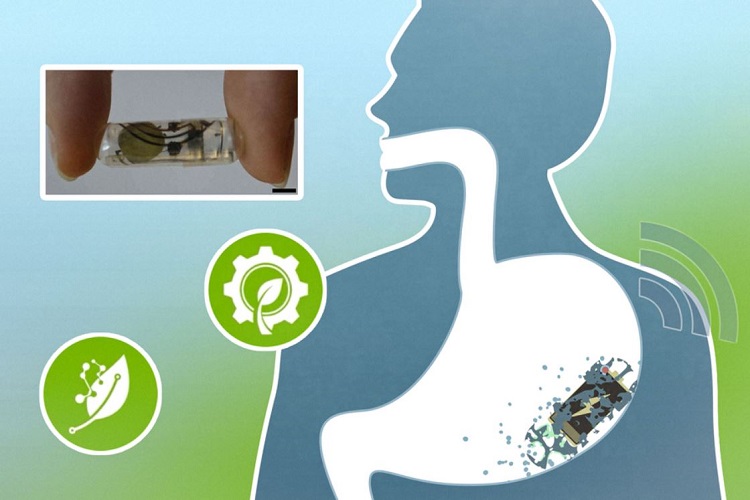 The MIT battery could be used to stimulate hunger in patients or used to monitor drug delivery and then absorbed by the stomach over weeks. Source: MIT
How it works
Magnesium is used to create the battery’s anode and molybdenum trioxide was used for the cathode. The battery also contains an ionic liquid gel electrolyte. MIT said this means the entire system is bioresorbable, or able to be fully broken down and absorbed into the body.
Two different versions of the battery were developed for different applications:
- A disc 7.5 millimeters in diameter
- A rectangular bar 24 mm long
Researchers tested the batteries by exposing them to gastric juice-like solution and found that the batteries function for about three days before the performance starts to falter. Within a few weeks, the batteries are completely absorbed.
Tests performed inside animals found that 20 minutes of electrical stimulation from the battery in the stomach boosted ghrelin levels by about 50%.
“What makes this work exciting is that we were able to show that a bioresorbable battery is not just a concept,” said Mehmet Girayhan Say, a former MIT postdoc and participant in the study. “It can actually power clinically relevant functions inside the gastrointestinal tract and then simply dissolve.”
How it communicates
Researchers embedded the battery into an RFID device to help patients adhere to a medication schedule. The capsule transmits its location from within the GI tract via a bioresorbable RFID tag made of molybdenum and cellulose.
Tests showed the tags could be powered by a disc-shaped bioresorbable battery and could transmit continuously from the GI tract with a range of up to 1.5 meters.
MIT said the researchers plan to start a clinical trial of the RFID medication-tracking capsule in about two years. The researchers said bioresorbable batteries could also cut the environmental toll of ingestible devices, since conventional batteries are eventually excreted into sewage systems.
“The benefits are twofold: One, the ability to be bioresorbable, but also the potential to minimize environmental impact because the materials will be degraded in the environment as well,” Traverso said.
The full research can be found in the journal Nature Chemical Engineering.