LNG Milestone as Ship Sails from Gulf Coast Terminal
David Wagman | April 03, 2017A decade ago, it seemed virtually certain that the U.S. would need to begin importing large volumes of natural gas to meet domestic demand.
Multiple proposals were made to build import terminals to receive shipment of liquefied natural gas from foreign suppliers, including Trinidad and Tobago and countries in the Middle East.
Hydraulic fracturing changed that calculus, and Cheniere Energy Partners, L.P. said that on April 1 the 100th cargo of liquefied natural gas (LNG) sailed from the company's Sabine Pass liquefaction facility, exported into the international market.
Since the first shipment on Feb. 24, 2016, Cheniere says it has delivered LNG cargoes to 18 countries on five continents.
Declining Imports
In mid-2016, the Energy Department's Energy Information Administration (EIA) said that natural gas net imports fell to 935 Bcf in 2015. Much of the imported natural gas comes from Canada. This decline continues a trend that began in 2007, when net imports of natural gas exceeded 3,785 Bcf.
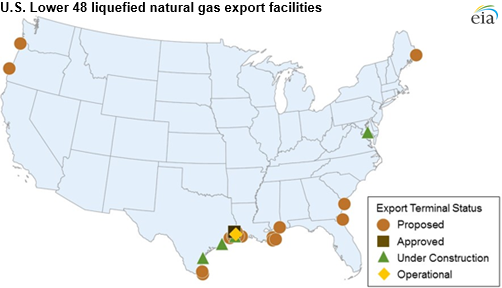 Energy Department map showing locations of LNG export terminal projects. Credit: EIAEIA said that net imports of natural gas declined because of increases in domestic natural gas production. Data showed a 5% increase in 2015 for domestic dry natural gas production to 27,096 billion cubic feet (Bcf), a record level for the United States.
Although both U.S. natural gas consumption and production have increased in recent years, natural gas production has grown slightly faster, EIA said. Rising domestic production of natural gas has kept U.S. natural gas prices relatively low.
In late March, Cheniere said that substantial completion of Train 3 of the Sabine Pass liquefaction project in Cameron Parish, Louisiana, was achieved. Under a sale and purchase agreement with Korea Gas Corp., the date of first commercial delivery for Train 3 is expected in June 2017.
LNG Process
LNG is produced by taking natural gas from a production field, removing impurities, and liquefying the natural gas. In the liquefaction process, the gas is cooled to around -260 degrees F at ambient pressure. This condensed liquid form of natural gas takes up about 1/600th of the volume of natural gas at a stove burner tip.
The LNG is loaded onto double-hulled ships which are used for both safety and insulating purposes. Once the ship arrives at the receiving port, the LNG is typically off-loaded into well-insulated storage tanks. Regasification converts the LNG back into its gas form, which enters the domestic pipeline distribution system and is ultimately delivered to the end-user.
Cheniere Partners is developing and operating natural gas liquefaction facilities at the Sabine Pass LNG terminal. Plans call for Cheniere to build up to six liquefaction trains, which are in various stages of development, construction, and operations.
Current Operations
There are more than 110 LNG facilities operating in the U.S. performing a variety of services. Some facilities export natural gas from the U.S., some provide natural gas supply to the interstate pipeline system or local distribution companies. Others are used to store natural gas for periods of peak demand. And some facilities produce LNG for vehicle fuel or for industrial use. Depending on location and use, an LNG facility may be regulated by several federal agencies and by state utility regulatory agencies.
 Detail of LNG export projects along the U.S. Gulf Coast. Credit: EIAThe Federal Energy Regulatory Commission (FERC) is responsible for authorizing the siting and construction of onshore and near-shore LNG import or export facilities under Section 3 of the Natural Gas Act.
The Commission, under Section 7 of the Natural Gas Act, also issues "certificates of public convenience and necessity" for LNG facilities involved in interstate natural gas transportation by pipeline. As required by the National Environmental Policy Act, the FERC prepares environmental assessments or impact statements for proposed LNG facilities under its jurisdiction.
As of January 2017, FERC reported the following LNG import and export projects in the U.S. and Canada:
Import Terminal Approved by FERC and Under Construction
- Corpus Christi, TX: 0.4 Bcfd (Cheniere – Corpus Christi LNG)
Import Terminal Approved by FERC but not Under Construction
- Salinas, PR: 0.6 Bcfd (Aguirre Offshore GasPort, LLC)
Import Terminal Approved by U.S. Maritime Administration/Coast Guard but not Under Construction
- Gulf of Mexico: 1.0 Bcfd (Main Pass McMoRan Exp.)
- Gulf of Mexico: 1.4 Bcfd (TORP Technology-Bienville LNG)
Export Terminal Approved by FERC and Under Construction
- Sabine, LA: 1.4 Bcfd (Cheniere/Sabine Pass LNG)
- Hackberry, LA: 2.1 Bcfd (Sempra–Cameron LNG)
- Freeport, TX: 2.14 Bcfd (Freeport LNG Dev/Freeport LNG Expansion/FLNG Liquefaction)
- Cove Point, MD: 0.82 Bcfd (Dominion–Cove Point LNG)
- Corpus Christi, TX: 2.14 Bcfd (Cheniere – Corpus Christi LNG)
- Sabine Pass, LA: 1.40 Bcfd (Sabine Pass Liquefaction)
- Elba Island, GA: 0.35 Bcfd (Southern LNG Company)
Export Terminal Approved by FERC but not Under Construction
- Lake Charles, LA: 2.2 Bcfd (Southern Union – Lake Charles LNG)
- Lake Charles, LA: 1.08 Bcfd (Magnolia LNG)
- Hackberry, LA: 1.41 Bcfd (Sempra - Cameron LNG) (CP15-560)
- Sabine Pass, TX: 2.1 Bcfd (ExxonMobil – Golden Pass)
Canada Approved but Not Under Construction
- Port Hawkesbury, NS: 0.5 Bcfd (Bear Head LNG)
- Kitimat, BC: 3.23 Bcfd (LNG Canada)
- Squamish, BC: 0.29 Bcfd (Woodfibre LNG Ltd)
- Prince Rupert Island, BC: 2.74 Bcfd (Pacific Northwest LNG)