Exhaled breath sensor could detect SARS-CoV-2 in minutes
Marie Donlon | August 25, 2026A specialized sensor capable of detecting viral particles in a person's breath has been developed by a team of researchers from Northeastern University.
Operating much like a breathalyzer, the new noninvasive test uses specialized gas-sensing technology to identify viral particles, offering results almost immediately.
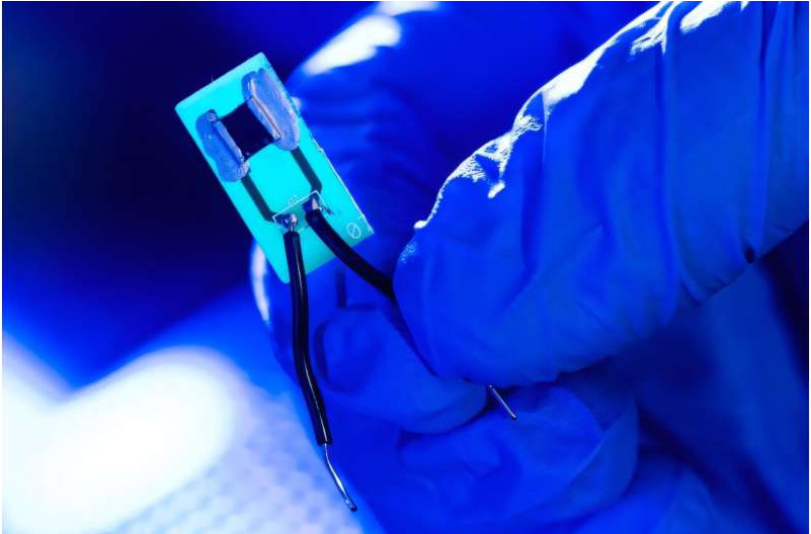 Source: Alyssa Stone/Northeastern University
According to its developers, the sensor, which was originally developed to detect airborne traces of illegal drugs and explosives, relies on a synthetic material called molecularly imprinted polymer (MIP). The MIP is molded around a target molecule or particle, creating a surface with puzzle-like cavities shaped to fit and capture it.
The MIP’s so-called cavities match the shape of a target virus or viral particle. Further, the sensor features a silicon base and a graphene layer, which together create part of the sensor’s electrical system that detects changes when the viral particle is present.
When a subject blows into the device, viral particles from their breath make contact with the sensorand subsequently bind to the microscopic cavities in the MIP layer. At this stage, they alter the sensor's electrical resistance, thereby creating a signal that can detect the virus, the team said.
The team noted that the device works best at the early stages of infection, the point at which a person is actively "shedding" the virus via the respiratory tract.
Although this sensor was developed primarily to detect SARS-CoV-2, the team is currently developing additional sensors capable of detecting other particles associated with different diseases, such as glucose for diabetes and certain RNA molecules for cancer detection.
Source: Northeastern University