"Laser Tweezers" Used to Assemble Micro Components
By Engineering360 News Desk | April 14, 2016Using "laser tweezers," engineers from Ruhr-Universität Bochum (RUB), in Germany, have demonstrated the ability to assemble microscopic components into larger structures—a method they say could be used to build micro-robots.
To assemble the tiny structures, the team, headed by Professor Cemal Esen, of RUB's Applied Laser Technologies lab, utilized optical tweezers, the arms of which are made up of strongly focused light. With the tweezers, they were able to manipulate objects in dimensions ranging between 0.5 and 20 micrometers.
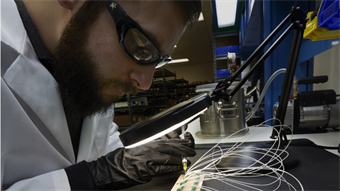
 The laser tweezers allowed manipulation of objects of between 0.5 and 20 micrometers. Image credit: © RUB/Damian Gorczany. With further development, the researchers say, this method could be used for manufacturing highly sophisticated micro-machines. “Such systems could be used for minimal invasive surgery,” says PhD student Sarah Ksouri.
The challenge is to design individual components that can be connected, but also disassembled if required. To that end, Ksouri has demonstrated that the technology can be used to connect microscopic jigsaw puzzles pieces that stick together because of their shape.
The first step of the process involves a 3D computer model of the object that is to be manufactured, which is subsequently realized using a two-photon polymerization technique, a type of micro 3D printer. The researchers apply a drop of photoresist to a slide, which is exposed to the laser beam in the locations indicated by the computer model. In the spots where the photoresist is exposed to the laser, a solid structure is formed and the remaining liquid is rinsed off with a solvent.
The team is simultaneously researching a number of different methods for combining two-photon polymerization and optical tweezers in a feasible manner. At present, the team is carrying out additional experiments with doped materials, i.e., enriched by nanoparticles from certain elements to give the polymer structures a specific function, such as magnetic or electrically conducting properties.
Ultimately, the goal is to integrate two-photon polymerization, optical tweezers and nano-doping into one device. In the first step, the device would generate functionless structures from polymers. Subsequently, nanoparticles would be applied to the structures to give them a specific function. And, finally, the structures would be assembled into larger ones.