Smartphone test spots microbial water contamination in under a minute
Marie Donlon | April 29, 2026A team of researchers at the Federal Institute for Materials Research and Testing (BAM) has created a portable rapid test capable of detecting contaminated water.
According to its developers, the test is designed to specifically detect the molecule urobilin because it is produced in the body during the breakdown of hemoglobin, excreted and thus behaves as a natural indicator that traces of human or animal excrement are present in water.
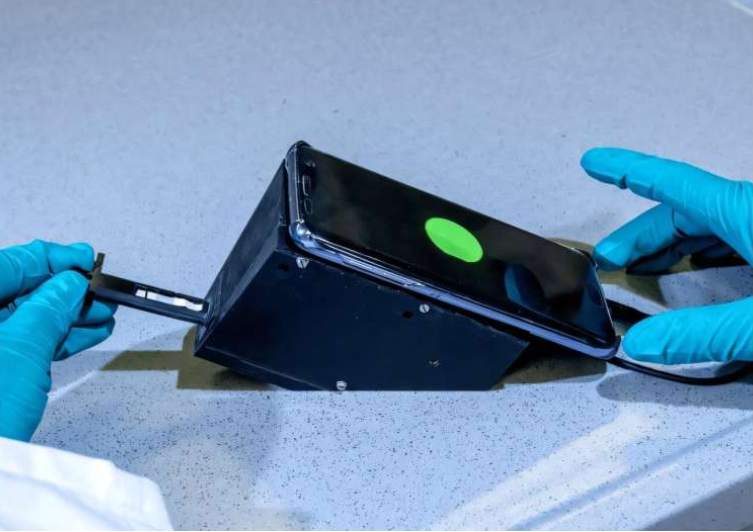 Source: BAM
Unlike conventional approaches to microbiological analysis, which can take up to 24 hours to complete, the new method is a highly sensitive detection technique that reportedly makes the urobilin, even in very low concentrations, visible within seconds. To accomplish this, a special test strip lights up upon coming into contact with microbiologically contaminated water.
The developers explained that the test can be performed directly when paired with a smartphone. A small LED lamp in a 3D-printed attachment of the test kit is powered by the phone, and the smartphone camera is used to measure the test strip's luminescence, and no additional lab equipment or chemicals are needed.
Just a single drop of water is sufficient to perform a reliable analysis, the team noted. During trials, the test strip reportedly demonstrated high stability and accuracy, with even very small amounts of the indicator molecule identifiable, which is markedly faster than with conventional analytical methods.
"The system also performed well in practical testing: The rapid test was successfully validated using real water samples from rivers as well as at the inflow and outflow of a Berlin wastewater treatment plant," explained the team. "Even under complex environmental conditions with natural interfering substances, urobilin was reliably detected."
The team suggests that the test is ideal for field operations, developing regions, crisis areas and mobile monitoring programs thanks to its simplicity, lack of lab equipment, speed, sensitivity and user-friendliness.
The study, “Rapid Onsite Detection of Fecal Contamination in Water Using a Portable Fluorometric Assay,” appears in the journal ACS Sensors.