New bio-based plastic becomes fertilizer after processing
Marie Donlon | September 19, 2026To tackle the growing global plastic waste problem, researchers from Chiba University, Tohoku University and the University of Tokyo have developed a bio-based plastic that can be converted into fertilizer.
The researchers found that a component of the plastic can be chemically converted into isosorbide (ISB) and urea when treated with aqueous ammonia. These compounds can then be used to produce materials that support plant growth. The team also developed a method to reduce the plastic’s hardness and brittleness.
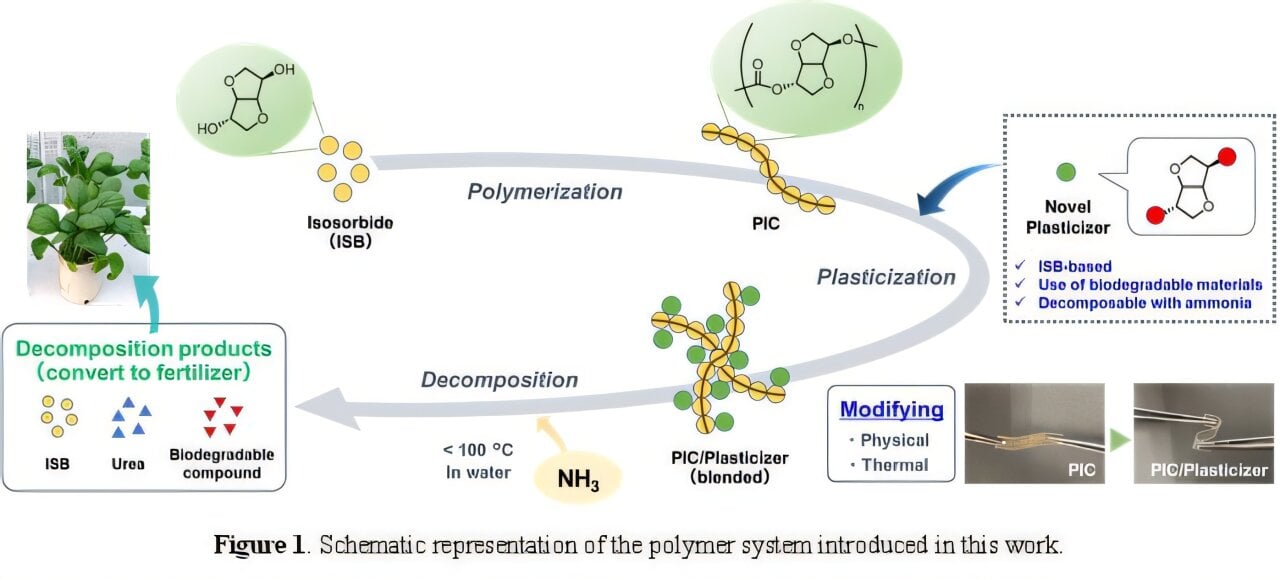 Source: Associate Professor Daisuke Aoki from Chiba University, Japan
To address the material’s hardness and brittleness, the team developed an ISB-based plasticizer that softens poly(isosorbide carbonate) (PIC) while making it 10 times more flexible. Despite these modifications, the resulting material can still be converted into fertilizer after use.
The researchers found that both the polymer and plasticizer can be broken down into fertilizer components through ammonia treatment. When exposed to aqueous ammonia at 194° F for 24 hours, both materials successfully degraded.
Without separation or purification, the resulting fertilizer supported the growth of a model plant — Arabidopsis thaliana, and the edible vegetable komatsuna (a variety of Brassica rapa).
The team envisions that the material might one day be used as a component in agricultural mulch films, seedling pots, plastic bags and packaging materials.
An article detailing the team’s work, “Plastics to fertilizer: A polymer system based on isosorbide as a monomer, plasticizer, and fertilizer,” appears in the journal Scientific Reports.