New smartwatch-like device promises to help detect plastic particles in the human body
Marie Donlon | April 08, 2026A team of researchers from the Institute of Computer Science at the University of Tartu is creating a wearable smartwatch-like device that is capable of measuring plastic in the human body.
Although nano- and microplastics are everywhere — in the air, food, water and clothing, for instance — recent studies have found that these plastics are present in the human body as well. However, detection of these plastics in the human body has proven challenging and typically requires invasive measures such as drawing blood and specialized equipment.
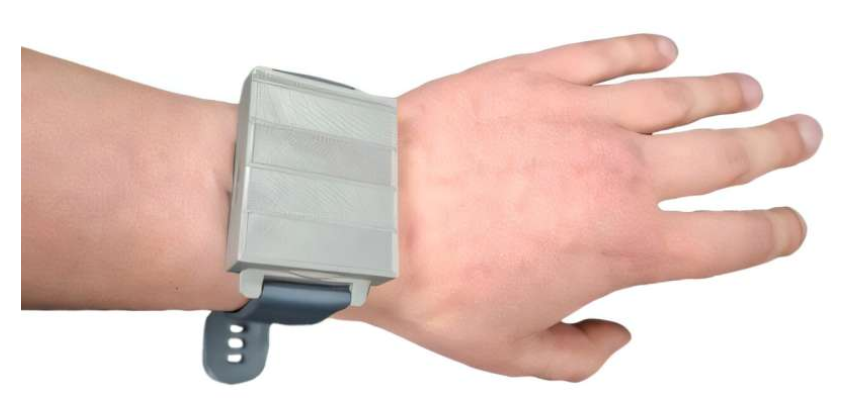 Source: Kevin Post
Studies in animals and cells suggest these microplastics can accumulate in the body, spread across tissues and potentially cause inflammation, oxidative stress and metabolic issues — particularly affecting the digestive and respiratory systems, though their full impact on human health is still unclear.
As such, the team set to work on an approach for measuring microplastic particles in humans so as to better understand how much plastic is currently in human bodies but without having to draw blood to “see inside” the body.
To accomplish this, the team relied on spectrometry, which is a method for analyzing how light interacts with materials. According to the team, this light-based sensing approach has already been used for detecting plastic particles in various environments, such as in soil and water.
"It works because different plastics reflect and absorb light in unique ways. They are like optical patterns that sensors can actually recognize. We're bringing that same idea into the human body using wearables, like smart watches, smart rings, and smart bands," the team explained. "Our approach uses a miniature spectrometer, essentially a tiny device that shines different colors of light and measures how each one bounces back. It can detect both visible light that we can normally see around us, and wavelengths like near-infrared and ultraviolet, that are invisible to the human eye."
With this approach, the team successfully detected plastic particles embedded beneath the surface of artificial skin in the lab.
An article detailing the work, “SWAN: Spectrometry-based Wearable Biosensing for Monitoring Plastic Particles in the Human Body,” appears in the journal Proceedings of the 27th International Workshop on Mobile Computing Systems and Applications.
For more on the approach, watch the accompanying video that appears courtesy of University of Tartu.