What it takes to design safe autonomous vehicle systems
Seth Price | February 25, 2026The most obvious speed bump for autonomous vehicle makers is ensuring that they do not collide with other vehicles, people or objects. However, that is only part of autonomous vehicle safety. Just like every piece of industrial equipment, autonomous vehicles must have fail safes and emergency stop mechanisms to prevent fire, unauthorized use and modification, ways to upload software patches and many other issues.
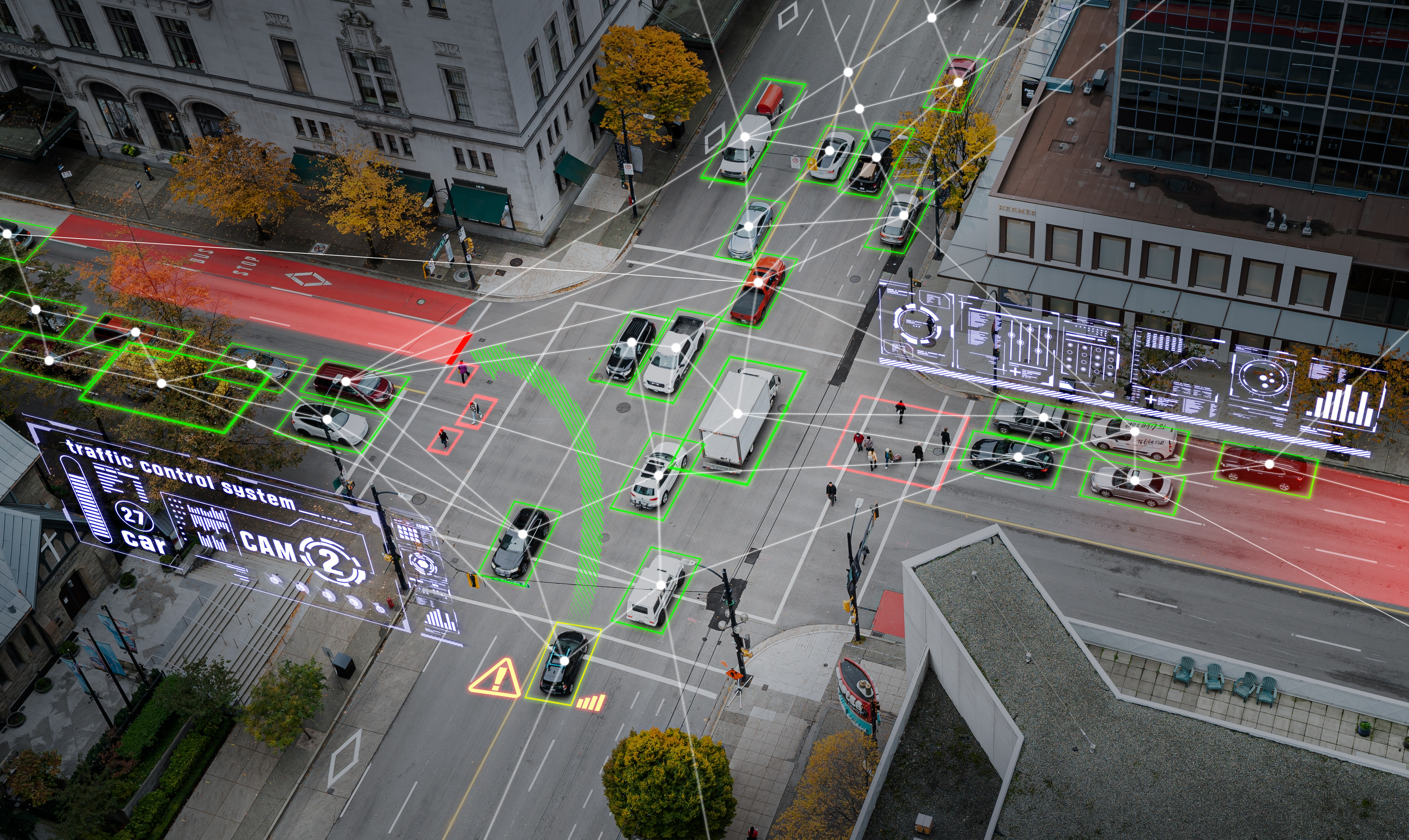 A complicated engineering problem: navigating safely with standard traffic lights. Source: Choi_ Nikolai/Adobe Stock
Safety engineering as a growing role
Fifty years ago, there was virtually no such role as “safety officer.” The formation of the U.S. Occupational Safety and Health Administration (OSHA) and other regulatory bodies has made safety a much larger concern as a whole across all industries. Bringing that mindset into the autonomous vehicle space, safety concerns and legal compliance require an entire staff, not just someone occasionally wearing a hat and performing a safety audit.
Autonomous vehicle safety engineer is perhaps a job title that was unheard of 10 years ago. However, it is becoming an ever-expanding career path. It encompasses everything from quality control to cybersecurity to data analysis and many other mission-critical jobs. A safety engineer might specialize in hardening the defenses to keep an autonomous vehicle safe from a cyberattack, or they might integrate manual fail-safes to override an autonomous vehicle’s algorithm in an emergency.
Software specific roles
One of the key challenges with autonomous vehicles is handling data from myriad sensors and cameras, and then efficiently using this data to make split second decisions. Companies that are developing autonomous vehicles are not just looking for run-of-the-mill computer programmers; they are looking for those familiar with optimizing CPU workloads and are well-versed in GPU architecture. Often, these roles require an advanced degree.
Waymo, a leading autonomous vehicle company, hires what they call “perception” or “optimization” software engineers to make the most use of limited computing power. They also emphasize machine learning and predictive algorithm design as key drivers for autonomous operation. Tesla tends to break down their opportunities by vehicle subsystem; chassis, drivetrain and so on.
In either case, another growing field is software integration engineering. These roles are needed to ensure that software from different subsystems communicate smoothly and reliably. Integration engineers must understand the big picture: the communications protocols, the hardware systems and sensors, as well as the software from multiple work groups, often spread out globally. Without proper integration, the entire vehicle’s safety is compromised.
The role of educational institutions
For years, universities have competed in autonomous vehicle challenges, though they have always been a student-driven (and often industry funded) endeavor. They filled the roles of side projects for undergraduates, or some component design would serve as a capstone project for senior engineers. Collegiate competitions encourage research in this field.
Competitions are not enough, however. Universities are seeing the need to develop entire centers aimed at AI and autonomous vehicle research. As an example, New Mexico Tech’s new Raul Deju Institute for Artificial Intelligence (AI) was founded to address the need for interdisciplinary problem solving and the gap in the pipeline of AI/automation ready engineers.
Other traditional universities have created multidisciplinary programs at the undergraduate and graduate level. Weber State University offers a post-baccalaureate certificate program in autonomous vehicle software, that is earned in tandem with a traditional master's degree in computer engineering, computer science or computer electrical engineering.
Community college and job-specific certifications
Many high school students are turning to community college or certification programs over traditional university life. This year saw a 3% growth in community college attendance, and there is no sign of plateauing in the near future. This represents a jump of 28%, as compared to four years ago. In terms of certificate completion, the number of students pursuing a certificate instead of a degree has also risen nearly 4%.
There are numerous theories about why community college attendance is on the rise, but common themes include a reduced cost as well as the ability to learn job-ready, transferable skills. While a university student might have to take a foreign language, art history or other classes to make them “well rounded”, many students are more interested in learning skills that will directly transfer to the work they wish to perform.
Community colleges are quickly adapting to the needs of the autonomous vehicle market. San Jacinto College in Houston now offers an autonomous vehicle certificate out of their auto tech program. Pima Community College offers an autonomous vehicle driver and operations specialist certificate that teaches students trucking and terminal operations for autonomous delivery trucks. Many of these programs are specializations embedded in auto tech, green technology or other such associate degree programs, and heavily emphasize safety protocols as part of the curriculum.
Outside of traditional schooling, organizations like the Society of Automotive Engineers (SAE) offer their own training courses, such as Autonomous Vehicle System Control and Architecture or Sensors for Perception for Autonomous Vehicle Development. These certificates are industry-recognized and do not require a college degree at all.
 AMRs can communicate with one another, stopping and starting in tandem. This allows for reduced following distances and very few collisions. Source: Vanitjan/Adobe Stock
The future
Ultimately, one of the hardest challenges is mixing human drivers with autonomous vehicles. As autonomous vehicles become more widespread, they will communicate with each other, as well as traffic control devices, making collisions less likely. Solving these challenges will require approaching problems differently. In some cases, it will require matching human behavior to machines and finding those who can integrate them properly. Whether certificate or PhD, safety is embedded in every program.
As camera and sensor technology improve and as computing power continues to rise in accordance with Moore’s Law (at least for now), the rise of autonomous vehicles is expected. It is no longer a question of “if” so much as a question of “when.”