Human knee–inspired robotic joints correct 99% misalignment, lend triple grip strength
Marie Donlon | February 23, 2026A team of engineers at Harvard University has created a new approach for designing robotic joints that replicate those in the human knee, potentially leading to more efficient robots and stronger grippers.
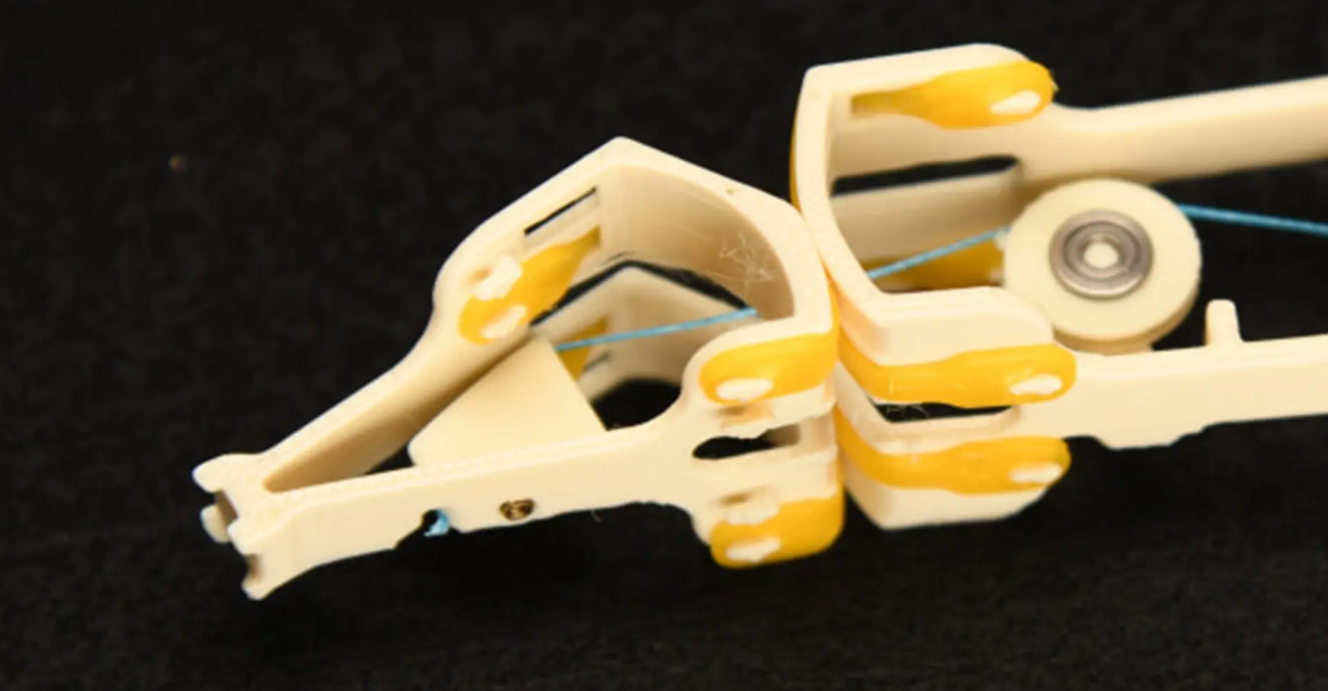
The new approach reportedly employs rolling contact joints, which are pairs of curved surfaces that roll and slide against each other and are held together with flexible connectors.
 Source: Harvard SEAS
According to its developers, the new method enhances the shape of each joint component according to the forces and tasks it must perform. This design enables the joint to efficiently direct energy, thereby reducing the need for large actuators and complex control systems.
“Whenever you have some robot, and you have an idea of what it needs to do — maybe it’s a walking robot — you can start to think about the best places to output force,” explained the researchers. “If we can embed those decisions into the mechanics of the robot itself, then we can create robots that are more efficient. They can use smaller actuators because the energy is targeted specifically where it needs to be.”
“We aim to offload as much motion control as possible to the mechanics and materials of the robot, so that the control system can focus on task-level goals. Colter’s methods do exactly that, and in a very elegant way, both mathematically and mechanically,” the team noted.
During trials, a knee-like joint enhanced with the new approach corrected misalignment by 99% when compared with a standard joint.
Meanwhile, a two-finger robotic gripper also enhanced with the new approach could reportedly hold over three times the weight of a gripper built with standard circular joints and pulleys for the same actuator input.
While traditional rolling contact joints use simple circular surfaces, the Harvard method can design irregular shapes that follow set paths and deliver sought-after force ratios along those paths.
“We did a bunch of math to say, if you have some specific desired trajectory that you want the joint to follow, and you have some specific force transmission ratio along that trajectory, can we find surfaces and pulleys that will exhibit those properties? Then we can apply that design process to optimize joints for tasks like walking, jumping, or grabbing,” the team added.
These optimized rolling contact joints could potentially be used in assorted applications ranging from assistive devices and exoskeletons to human-like robots and biomechanical studies of animals.
The study, “Noncircular rolling contact joints enable programmed behavior in robotic linkages,” was published in the journal Proceedings of the National Academy of Sciences.
For more on the joints, watch the accompanying video, which appears courtesy of Harvard.