"Smart" Prosthetic Limb Earns Top UK Engineering Award
John Simpson | July 17, 2016Orthopedics manufacturer Blatchford has won the UK's top innovation prize for its advanced prosthetic limb, which incorporates robotic control of the knee and foot to create a system in which the parts work together like a human leg.
The Linx—which earned the Royal Academy of Engineering's MacRobert Award—uses a network of sensors across both the knee and foot that act like human nerves, continuously collecting data on the user, activity, environment and terrain. A central computer uses the data to adapt the limb’s response using Mi² (motion-integrated intelligence) software. The result is that the wearer can walk more confidently, knowing that the limb will move at the right speed and provide adequate support.
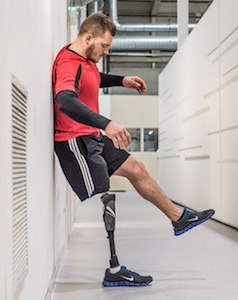 The Linx ankle "talks" to the knee at the rate of 400 messages per second. Image credit: Blatchford.When a patient is first fitted with the Linx, a clinician programs its central computer by running through a calibration sequence so the limb learns how its wearer naturally walks and adapts accordingly. This is carried out via Bluetooth connection to a software app that shows in real time what the sensors are picking up as it detects the wearer’s natural walking speed and movements.
A smart algorithm then calibrates the limb so the knee and foot joints communicate with each other. Previous prosthetics would require each joint to be calibrated in turn in a lengthy process that would often require repeated adjustments.
According to Blatchford, the Linx ankle "talks" to the knee at the rate of 400 messages per second. In the course of a typical day, the prosthetic limb will adjust over 2,000 times to adapt to its environment.
Even standing still can be a challenge for lower-limb prosthetic wearers, who typically must expend significant energy and concentration to hold the leg steady. The Linx senses when the wearer comes to a standstill and automatically locks so that the wearer can relax; when he or she wants to move again, the sensors quickly unlock the limb.
In England alone, there are approximately 45,000 people who rely on lower-limb prostheses and an additional 4,000 lower-limb amputations carried out each year. Despite a high price point, Blatchford says Linx can save patients money over the long term by potentially reducing secondary treatments required for back pain, arthritis, falls and joint replacements—as well as by extending the life of sockets, which could lessen patients' need for carers.