This catalyst cuts the cost of hydrogen production
S. Himmelstein | February 12, 2026Platinum catalysts have been deemed essential in the electrolytic production of hydrogen, but the high cost of this component can detract from the economic feasibility of green hydrogen. An affordable alternative that reduces the amount of platinum consumed during the process is being advanced by an international research team.
Some of the platinum required is replaced with nickel and cobalt and mounted on tiny structures made of hollow carbon nanospheres to hold the metals in place and maximize the surface area for the chemical reaction. While a typical catalyst contains around 20% platinum by weight, the new version uses around five times less platinum — just 4% by weight — which represents substantial cost savings.
“The catalyst uses the same total amount of material, just with less platinum, to produce the same amount of hydrogen,” explained the researchers.
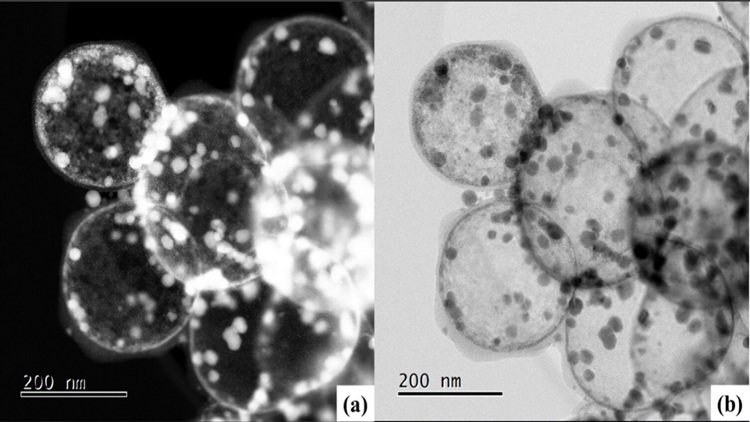 Catalyst structure at the nanoscale. Source: doi.org/10.1021/acsaem.5c02821
Tests with a highly efficient platinum-nickel-cobalt/hollow carbon sphere trimetallic catalyst with less than 4 wt% platinum demonstrated superior hydrogen evolution reaction performance compared to the commercial 20 wt% platinum catalyst. Despite the significantly lower platinum loading, the revised catalyst exhibited a remarkably low onset overpotential of 0.3 mV comparable to that of the more conventional and costly option. Durability tests described in ACS Applied Energy Materials also confirmed that the newly formulated catalyst maintained stable performance over 24 hours.
Researchers from the University of the Witwatersrand (South Africa), Max Planck Institute for Solid State Research (Germany), Brazilian National Synchrotron Light Laboratory (Brazil), Canadian Light Source Inc. (Canada), Brazilian Nanotechnology National Laboratory (Brazil) and Nelson Mandela University (South Africa) contributed to this development.