Biodegradable starch sachets gradually deliver fertilizer without petroleum plastics
Marie Donlon | February 15, 2026Collaborators from the National Nanotechnology Laboratory for Agriculture (LNNA) of EMBRAPA Instrumentation, the Brazilian Agricultural Research Corporation and the Federal University of São Carlos (UFSCar) have jointly developed a product that promises to replace polymers used in soil fertilizers.
This solution includes starch sachets reinforced with nanoparticles featuring powdered or granulated fertilizers, with the collaborators explaining that starch is a biodegradable polymer that in sachet form can be filled with a mix of assorted nutrients essential for crops.
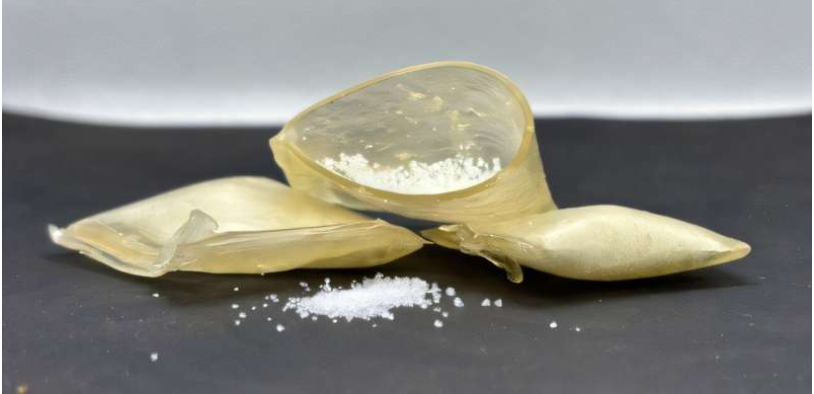 Source: João Otávio Donizette Malafatti
"There are essential and irreplaceable nutrients for plants, such as the trio of nitrogen, phosphorus, and potassium [NPK] — usually applied to the soil in the form of highly soluble potassium chloride salt. Farmers generally apply a large amount to the field to ensure absorption. However, the cultivated plant cannot immediately absorb all of this fertilizer," the team noted. "This excess becomes an economic loss and can contaminate the surrounding environment. The sachets aim to control the release so that the plant feeds gradually. In this sense, we modulate different types of sachets depending on the nutrients we're going to add inside them."
The starch sachets were processed with urea and citric acid and then reinforced with zeolite rich in copper ions. Zeolite was selected because it is a porous mineral with a high adsorption capacity for ions, including copper.
Because starch degrades easily, the sachets demand a special formulation to remain intact until reaching the soil, where copper ions in zeolite inhibit microbial growth and offer micronutrients that plants can absorb.
The team explained that while the presence of copper controlled the growth of the fungus Alternaria alternata, the aim is to strike a balance between preserving the sachets in the final application in the soil while simultaneously making their contents available to the external environment.
The research suggests that biodegradable starch-based polymers still fall behind petroleum-derived materials in terms of strength and long-term stability, thereby prompting efforts to improve their formulations. Specifically, lab tests showed that adding up to 3% zeolite improved mechanical resistance, while higher amounts caused particle clumping, which weakened the material. Likewise, zeolite encouraged water retention during drought thanks to its porous, hydrophilic nature, functioning much like a tea bag that holds and releases fertilizer.
The team explained that the sachets proved versatile because they increased the solubility of stored fertilizers and controlled the release of highly soluble sources, thus reducing fertilizer loss via aerial dispersion and leaching from rainfall.
In related research conducted by the UFSCar team, hydroxyapatite, a phosphorus source, was identified as a fertilizer candidate. With the aim of increasing solubility, the team discovered that acidifying the medium with pectin in the starch sachet composition increased solubility when mixed with nanoparticulated hydroxyapatite.
The team discovered that the starch-based fertilizer sachets gelled when they were exposed to water, thus helping keep nutrients in the soil and reducing losses from rain, wind, leaching or dispersion. Designed for sustained release, the sachets gradually delivered soluble fertilizers, as shown in 30-day lab tests that confirmed partial nutrient release and effective water permeation. Further experiments found the materials to be environmentally safe and capable of increasing copper availability in acidic conditions. While still in the early stages, the technology offers customizable, safer fertilizer delivery for assorted crops and shows promise for future agricultural use.
An article detailing the technology, “Copper-Modified Faujasite Zeolite Reinforcement in Biodegradable Starch Sachets for Potassium Fertilizer Releasing,” appears in the Journal of Inorganic and Organometallic Polymers and Materials.