Soft, air-powered robotic elbow exoskeleton eases muscle effort, reduces workload
Marie Donlon | November 15, 2025Engineers at the University of Texas at Arlington have created a soft robotic exoskeleton for reducing the strain on the wearer’s arm and elbow.
Designed particularly for workers whose jobs involve hours of lifting and repetitive motion and to prevent future musculoskeletal disorders, the Pneumatically Actuated Soft Elbow Exoskeleton (PASE) is a lightweight silicone "pneumatic actuator."
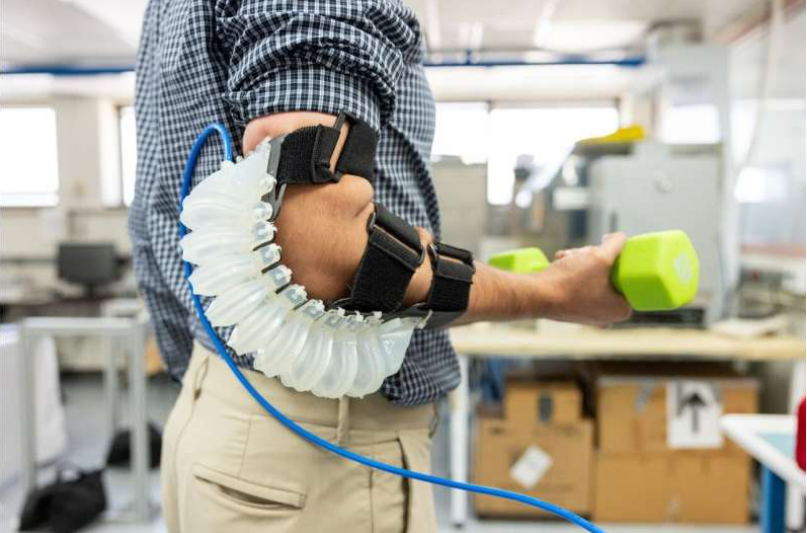 Source: University of Texas at Arlington
The soft, air-filled mechanism helps move the arm as the wearer performs everyday industrial tasks such as lifting, assembling and drilling. Thanks to its flexible design, the device is expected to lower the risk of developing work-related musculoskeletal disorders.
"Our goal was to create a preventive, assistive device that reduces muscle strain before injuries occur," the researchers explained. "By using the pneumatic systems already available overhead in most manufacturing facilities, this exoskeleton can be easily implemented in real-world settings."
PASE was designed as a single-piece pneumatic actuator, thereby minimizing weight and mechanical complexity while simultaneously maximizing comfort and freedom of movement, the team noted. The device is comprised of silicone and mounted on a carbon-fiber onyx base plate featuring a soft neoprene outer layer.
During trials of the device, 19 participants aged 18 to 45 wore the exoskeleton while performing three tasks: manual weightlifting, basic assembly and power drilling. The team determined that when the exoskeleton support was engaged, muscle activity in the wearers’ biceps and triceps decreased by roughly 22% as they performed lifting tasks. Additionally, participants reported 8 point to 10 point reductions in the wearers’ perceived physical and mental workloads using NASA's Task Load Index versus when the support was off.
The study, "Design, Development, and Evaluation of a Pneumatically Actuated Soft Wearable Robotic Elbow Exoskeleton for Reducing Muscle Activity and Perceived Workload," appears in the Journal of Rehabilitation and Assistive Technologies Engineering.