Rethinking reach: Designing assistive exoskeletons for the upper limbs
Jody Dascalu | October 08, 2025Assistive upper limb exoskeletons are wearable robotic devices that support or restore movement in the arms and hands. Unlike prosthetics, which replace a missing limb, they augment the existing anatomy by providing mechanical assistance at the shoulder, elbow and wrist. Designs range from powered systems using motors or pneumatics to passive frames that redistribute load through springs and lightweight structures.
Their relevance is growing as demographic and occupational pressures converge. Aging populations face rising rates of stroke and degenerative conditions requiring long-term rehabilitation, while industrial and service workers contend with fatigue and repetitive strain from overhead tasks. These demands highlight the need for technologies that extend physical capacity while preserving user autonomy.
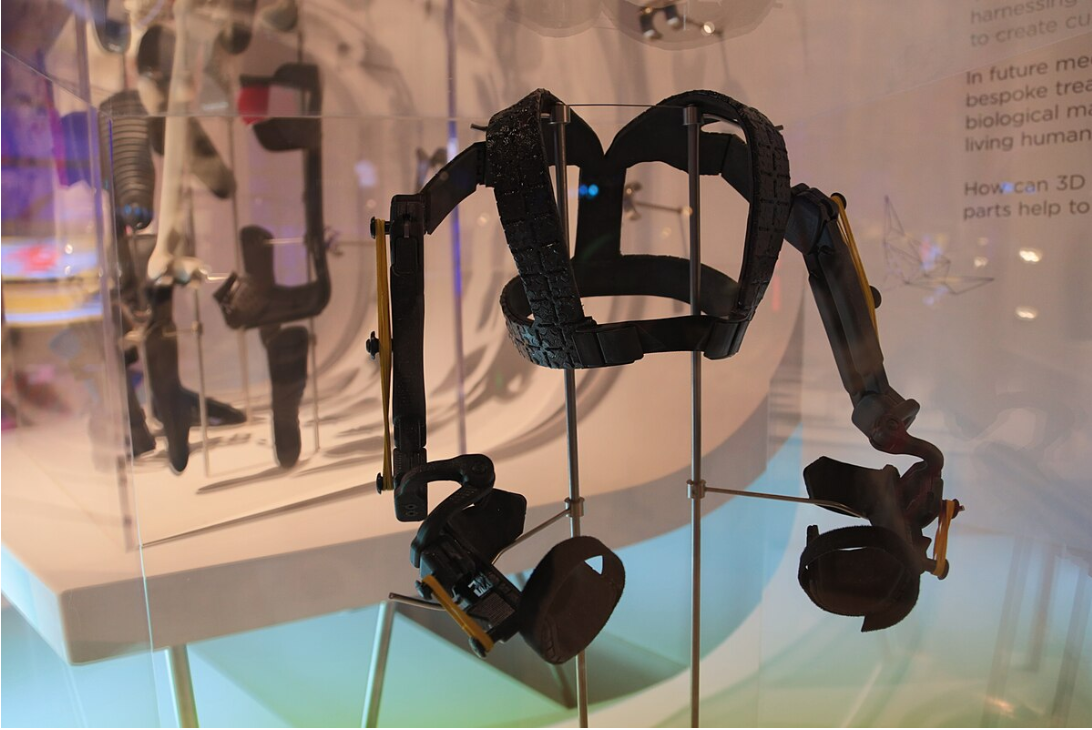 Exoskeleton on display. Source: John Cummings/CC BY-SA 3.0
A field in transition
Early exoskeleton concepts were born in military and industrial research during the mid-20th century, imagined as ways to give soldiers or workers superhuman strength. Those prototypes were bulky, tethered machines that rarely advanced beyond the lab. What has changed in recent decades is the convergence of lighter materials, compact motors and wearable robotics developed for rehabilitation. Instead of chasing raw augmentation, modern designs target practical needs: restoring movement after stroke, maintaining mobility in degenerative conditions and reducing fatigue in repetitive work.
The most novel developments today come from two directions. On the hardware side, soft exosuits built from textiles, cables and inflatable structures are moving away from rigid frames toward designs that resemble clothing, making assistance less stigmatizing and more comfortable. On the control side, machine learning and intent-detection algorithms are being tested to anticipate motion rather than just respond to it, reducing lag and making the device feel more like an extension of the body. Both trends mark a departure from the heavy, one-size-fits-all models of the past.
As a result, upper limb exoskeletons are now tools shaped by measurable clinical and ergonomic demands. They are calibrated for consistent assistance, whether in a clinic where repetition drives recovery, or on a factory floor where reducing shoulder load can prevent long-term injury. This shift from futuristic vision to practical integration defines their present importance and frames the design and usability questions that follow.
Designing machines that move like the body
The first design challenge is anatomical. Human joints rarely behave like simple hinges, and the shoulder is especially complex, shifting its center of rotation as the arm elevates. Even small mismatches between biological and mechanical axes can produce discomfort, restricted range or long-term strain. Effective systems therefore rely on detailed biomechanical mapping and adjustable linkages that allow the frame to track individual variation.
Weight is the next limiting factor. A device that generates torque but feels like strapping on gym equipment will quickly be abandoned. Added mass increases inertia, reduces responsiveness and makes movement feel less natural. Designers must strike a balance between structural strength and lightness, experimenting with frame geometries and advanced materials to achieve both.
Power adds another layer of compromise. Electric motors deliver precise control but are heavy and noisy; pneumatics provide smooth, muscle-like motion but require compressors or tubing; passive systems avoid power demands entirely yet offer only modest support. Energy supply compounds the difficulty. Tethered devices perform well in clinics, but battery-powered systems, though more mobile, remain constrained by operating time and bulk.
Material choice ties these factors together. Composites such as carbon fiber reduce fatigue while maintaining strength, though at high cost. Textile-based “soft exosuits” attempt a different path, replacing rigid frames with fabrics, cables or inflatable structures that emphasize comfort and discretion. These offer promise in reducing stigma and improving wearability, but they cannot yet match rigid systems for raw output.
Taken together, these considerations illustrate how closely engineering and usability are bound. A device must provide reliable assistance while remaining light, natural and safe enough for everyday use. Without that balance, even the most capable system risks rejection.
When technology meets comfort, trust and control
Usability in exoskeleton design is not an afterthought but the determining factor of adoption. A device that delivers measurable torque but causes skin pressure, heat buildup or restricted circulation will fail outside a lab. Adjustable fittings and ergonomic load distribution are as critical as actuator performance, since even minor discomfort compounds during long-term wear.
Equally important is kinematic transparency, the extent the device follows the body without noticeable delay or resistance. Control strategies approach this challenge differently: electromyography can capture pre-movement muscle signals, force sensors react to mechanical load, and intent-detection algorithms use predictive modeling to reduce lag. Each method has trade-offs in accuracy, cost and user training requirements, but all aim to make the system behave as a natural extension of the limb.
Trust develops only when safety and predictability are evident. Smooth motion trajectories, low jerk and reliable fail-safe mechanisms reassure the user that the system will not destabilize unexpectedly. Psychological acceptance is inseparable from these engineering factors: if the machine feels unpredictable, heavy or socially stigmatizing, long-term compliance drops, regardless of technical capability.
Case studies and applications
In rehabilitation, upper limb exoskeletons are used to help patients recover movement after stroke or injury. These devices are often tethered, precise and designed for clinical supervision, focusing on repetitive, controlled motions that retrain muscles and nerves.
In contrast, workplace applications emphasize endurance and fatigue reduction. Here the priority is not precision but sustained support, helping workers perform overhead or forceful tasks for longer periods without strain. Devices for these environments tend to be lighter, more rugged and easier to put on and take off.
Alongside these uses, a new generation of soft exosuits and hybrid designs is beginning to blur the line between clinical and industrial applications. By relying on fabrics, cables and lightweight actuators, they aim to make assistance feel more like clothing than equipment.
The difference between these settings highlights the central divide: clinical exoskeletons prioritize accuracy and therapeutic effect, while industrial ones focus on comfort and stamina in demanding environments.
Barriers and future directions
High cost remains the main obstacle to widespread adoption. Combining lightweight structures, precise actuators and reliable power supplies drives prices beyond reach for most clinics and workplaces. Reducing cost without sacrificing function is the central engineering and manufacturing challenge.
Another issue is scaling customization. Exoskeletons perform best when fitted closely to the user, yet one-off tailoring raises complexity and expense. Modular, adjustable architectures are being explored as a compromise between individual fit and scalable production.
On the horizon, advances in machine learning and predictive control may allow systems to anticipate motion instead of only reacting, improving transparency and reducing cognitive load. Soft robotics and bio-inspired actuation promise designs that behave more like biological tissue than mechanical frames, further blurring the line between body and machine.
Technical progress alone will not decide adoption. Social acceptance, stigma and questions of autonomy remain just as influential. For exoskeletons to move from prototypes to daily tools, they must be not only functional but trusted.