Microplastics mapped in the marine environment
S. Himmelstein | June 02, 2025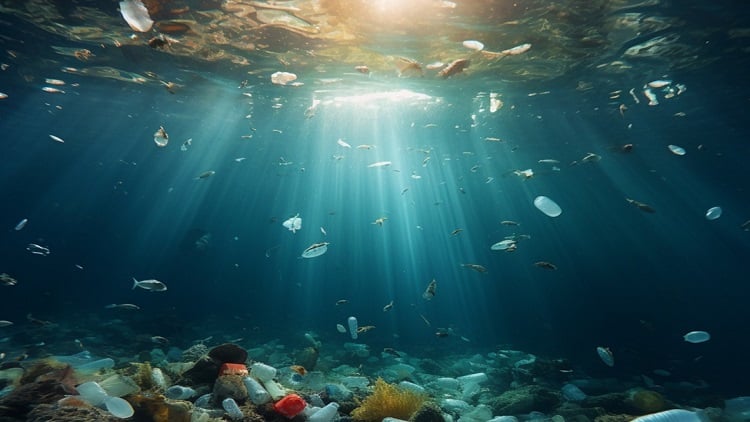 Microplastics distribution was mapped from the surface to the deep sea at a global scale. Source: Florida Atlantic University
Plastic pollution plagues the world’s oceans, with up to 14 million metric tons of this pervasive material entering marine waters annually. To monitor the extent of plastic’s presence, researchers have typically focused on samples collected in the top 15 cm to 50 cm of water systems. As these studies do not document the entire breadth of contaminant travel, an international research team mapped microplastic distribution from the surface to the deep sea at a global scale.
The analysis covered depth-profile data from 1,885 stations collected between 2014 and 2024 and identified more than 56 types of plastic polymers. The study published in Nature reveals that smaller microplastics in the 1 micrometer to 100 micrometers range spread more evenly and penetrate deeper. Particles of 100 micrometers to 5,000 micrometers tend to collect near the surface.
While buoyant plastics dominate overall, denser microplastics are more prevalent offshore, likely because they become brittle and break down faster due to environmental weathering. The analysis also confirmed that polypropylene photodegrades more quickly than polyethylene, which may account for its lower abundance in offshore waters.
Scientists from the Japan Agency for Marine-Earth Science and Technology, Aotearoa Blue Ocean Research (New Zealand), Northeastern University, NIOZ Royal Netherlands Institute for Sea Research, The Ocean Cleanup (the Netherlands), Florida Atlantic University, Centre for Ecology and Sustainable Management of Oceanic Island (Chile), Harvard University and University of Siena (Italy) participated in this research.