
Closing the loop: Conveyor-based error reduction in high-volume fulfillment
Jody Dascalu | June 15, 2025Order accuracy is a critical factor in modern fulfillment operations, directly impacting customer satisfaction, operational efficiency and cost control. As demand for faster, high-volume order processing grows, traditional methods of material handling struggle to keep pace, often leading to mispicks, shipment errors and costly returns.
Conveyor technology plays a role in mitigating these challenges by integrating automation, precision control and real-time tracking. Advanced conveyor systems streamline material flow and also enhance accuracy by reducing human error, improving sortation precision and synchronizing seamlessly with warehouse management systems.
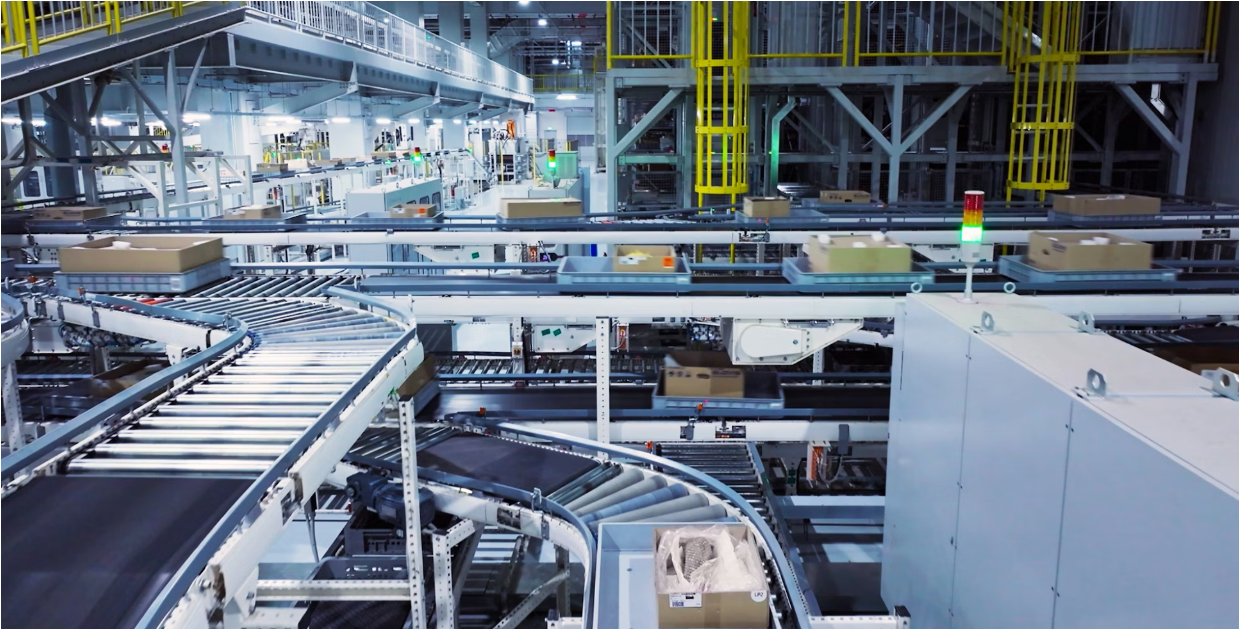 Cargo on conveyor belt. Source: Hyundai Motor Group/Unsplash
The impact of order inaccuracy
Order inaccuracy affects multiple facets of fulfillment operations, often cascading through workflows and increasing operating costs. Every mispicked or misrouted item results in unnecessary handling, from returns processing to restocking, leading to elevated labor expenses and extended cycle times. Even minor error rates can have disproportionate effects on operational efficiency, especially under high-volume or time-sensitive conditions.
At a systems level, inaccuracies disrupt the flow of materials and information. Items that are misplaced or packaged incorrectly can cause congestion on conveyor lines, forcing manual interventions that undermine automation. Unverified weights and dimensions are also a source of errors; without precise measurement, downstream sortation and scanning devices are more prone to mismatches.
Contributing factors include manual handling deviations, inadequate scanning or validation steps, and variability in package size or orientation, any of which can slip through if the conveyor system and its associated sensors are not fully integrated. The emergence of more diverse SKUs and the rapid turnover of inventory further exacerbates these challenges. To address them effectively, a conveyor system must offer accurate tracking, built-in validation and adaptive controls that respond immediately to irregularities.
Conveyor technologies enhancing accuracy
Conveyor systems designed for high order accuracy rely on advanced sensing capabilities, data-driven controls and real-time analytics. By leveraging innovations such as machine vision, 3D scanning and intelligent software, these platforms reduce error-prone manual work and create a seamless flow of materials.
Automated sortation systems
Modern automated sortation extends beyond barcode or RFID checks, employing higher-fidelity scanners and even camera-based vision systems. These systems verify item orientation, detect package deformities and route items to dedicated lanes based on SKU or order priority. When a mismatch occurs, whether due to weight, dimension or barcode discrepancies, the affected package is diverted to a quality-control area, preventing a single anomaly from propagating through the entire order stream. Basic sorting systems using infrared sensors and microcontrollers lack the adaptability required for high-volume fulfillment centers. Modern conveyor technology integrates machine vision and AI-driven analytics, enabling dynamic adjustments that reduce sorting errors and improve overall throughput.
Smart conveyor sensors and controls
Sensors embedded in the conveyor track speed, orientation and spacing of individual items. With machine-learning–driven analytics, the system can predict potential issues, such as item collisions or capacity overload, and automatically adjust conveyor speed or schedule maintenance checks. In some setups, 3D scanning technology complements conventional barcode systems to ensure that any irregular shape or poorly labeled package is still recognized. This proactive approach maintains a balanced throughput and minimizes operator intervention by detecting anomalies the instance they occur.
Weighing and dimensioning integration
Inline weighing and dimensioning units serve as an additional validation checkpoint. By comparing each package’s measured attributes to stored data, the system immediately flags outliers for further inspection. This step is especially crucial for fulfillment centers handling diverse or irregularly shaped items, where standard scanners might fail. Coupled with advanced sensor arrays, inline weighing and dimensioning can support automated orientation correction or real-time volumetric calculations for optimized trailer loading. The result is a more holistic validation method that reduces mispicks, refines shipping cost estimates and ensures safer handling of items prone to damage.
Integrated with robust analytics software, these conveyor technologies provide continuous improvement loops. Data collected from scanners, dimensioners and sensors feed into predictive models that anticipate shifts in demand or product mix. Over time, the system learns from each exception, recalibrating thresholds or suggesting layout adjustments to prevent recurring mistakes. This combination of automation, high-fidelity sensing and adaptive algorithms boosts accuracy, keeping pace with the evolving demands of modern fulfillment operations.
System integration for error reduction
Synchronizing the warehouse management system (WMS) with conveyor controls helps to ensure accurate routing, consistent inventory updates and continuous visibility of item flow. When orders are released, the WMS relays item identifiers, routing instructions and priority data to the conveyor system’s programmable logic controllers (PLCs). Sensors and scanners along the conveyor path capture package attributes like weight, dimensions and barcode identifiers, then transmit this data to the WMS. This bidirectional communication maintains synchronized data across all subsystems, providing a unified real-time overview of each item’s status.
Machine learning further refines this process by analyzing historical sensor and WMS data to identify patterns linked to mispicks, dimension mismatches or other anomalies. Predictive models then suggest adjustments to conveyor speed, scanning thresholds, or routing paths. For example, if the system detects higher error rates for a particular SKU, it can reroute those items through a more thorough scanning station. Over time, these algorithms adapt to shifts in order volume, product variety or packaging standards, providing a proactive approach to reducing errors and streamlining throughput.
Considerations for implementation
A high-accuracy conveyor system requires careful planning around workflows, scalability and maintenance. Decision-makers should evaluate how products move through the facility, where scanning or weighing is needed, and which conveyor type best supports operational efficiency.
Choosing the right system
Product dimensions, weight, throughput targets and future capacity needs determine whether a belt-driven, roller, or modular system is most effective. Facilities handling diverse SKUs may benefit from modular conveyors that accommodate specialized scanning or sorting stations.
Scalability and flexibility
Conveyors should be adaptable to throughput spikes, product mix changes and layout modifications. Configuring segments for easy expansion, such as adding new lines or parallel routes, helps maintain accuracy as demand grows.
Maintenance and reliability
Regular inspections of sensors, barcode readers, motors and PLCs prevent disruptions. Predictive maintenance and remote diagnostics further enhance reliability by identifying potential failures before they impact operations.
Future of conveyor technology in order accuracy
As fulfillment operations grow in complexity, conveyor technology will continue evolving beyond traditional automation. The next phase of development will integrate robotic handling, AI-driven predictive maintenance and energy-efficient designs, reducing downtime while optimizing throughput. Advances in computer vision and digital twin simulations will enable real-time system adjustments, further minimizing order errors. Organizations that prioritize scalable, data-driven conveyor solutions will stay ahead in an industry where speed, accuracy and adaptability define success.


When I was the engineering manager (mechanical) at a OEM, I had one of the my engineers design a conveyor system that takes String Cheese out of the brine lake and into a 7 zone conveyor systems.where and zone and combination of zones to packaging.
The automation engineer (another department) that he could do it as gates, he that the amount of combinations of gates would be like 21. I told him it’s more than that. And told him to draw it out first.
1
1, 2
1, 3
1, 4
1, 5
1, 6
1, 7
1, 2, 3
1, 2, 4
…
ect…