How smart warehouses are reshaping distribution networks
Jody Dascalu | July 15, 2025Smart warehouses are advanced facilities that use automation, real-time data and intelligent systems to manage inventory and optimize operations. They are designed to reduce human intervention and improve accuracy, speed and efficiency in storage, picking and distribution. Traditional warehouses, which rely heavily on manual labor and disconnected systems, are increasingly being replaced by integrated, automated environments. This shift is driven by the demand for faster deliveries, fewer errors and better adaptability to changing market conditions.
Key technologies in smart warehousing
Smart warehouses operate through a coordinated system of advanced technologies that automate logistics functions, increase throughput and enable real-time operational visibility. Central to this system is the warehouse management system (WMS), which acts as the digital control layer. It manages inventory tracking, order processing and internal workflows while integrating with other technologies to provide full oversight from receiving to dispatch.
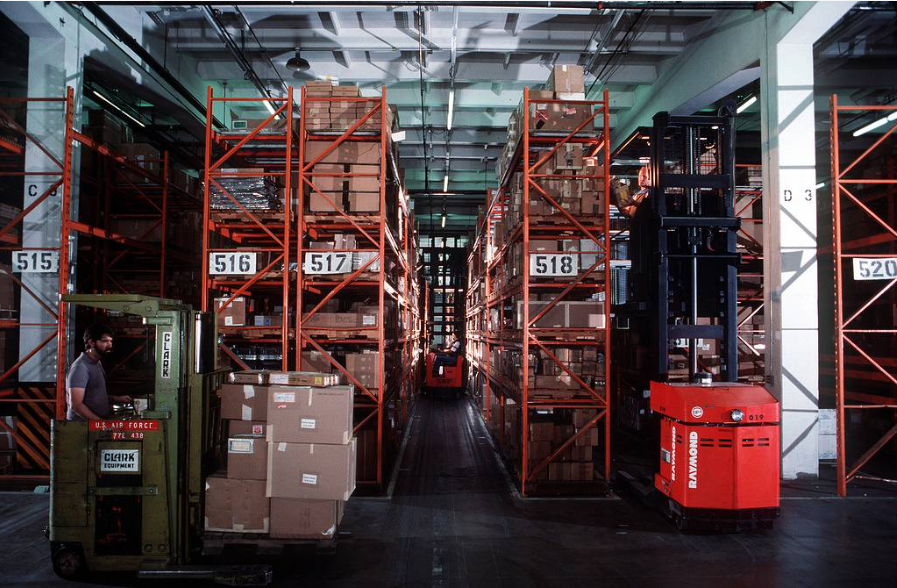 Workers using computerized forklifts in an automated warehouse. Source: Public domain
Robotics and automated guided vehicles (AGVs) perform repetitive or physically intensive tasks such as picking, sorting and transport. These machines reduce labor dependency, improve consistency and support higher operational volumes. Some warehouses also use robotic arms and collaborative robots that work safely alongside human operators to increase flexibility.
Internet of things (IoT) sensors and RFID tags collect continuous data on the location, condition and movement of goods and equipment. This supports real-time monitoring, bottleneck detection and process optimization.
Artificial intelligence (AI) and machine learning (ML) analyze warehouse data to forecast demand, optimize stock placement and improve routing. These systems adapt over time to improve efficiency and accuracy.
Cloud computing and real-time data platforms enable remote access, scalable infrastructure and seamless system integration. Together, these technologies enable a shift from reactive to predictive and autonomous warehouse operations.
Operational improvements enabled by smart warehousing
Smart warehousing enables substantial operational gains by automating key processes and integrating real-time data across all functional areas. One of the most immediate impacts is accelerated order fulfillment. Technologies such as automated picking systems, conveyor networks and AI-driven routing algorithms significantly reduce the time between order receipt and dispatch. These capabilities are especially valuable in high-throughput sectors such as e-commerce and food logistics, where fulfillment speed directly influences service levels.
Beyond speed, automation reduces the incidence of human error in order processing. Systems for labeling, scanning and product handling enhance accuracy in picking and inventory control, resulting in fewer returns, reduced waste and higher customer satisfaction. Real-time visibility through RFID and IoT integration allows for continuous inventory monitoring, minimizing both stockouts and overstock situations. Predictive analytics further support strategic decision-making related to replenishment cycles and storage allocation.
Smart warehouses also contribute to energy and space optimization. Vertical storage systems, combined with automated retrieval technologies, increase storage density while maintaining high throughput in limited physical footprints. Integrated energy management platforms monitor consumption patterns and detect inefficiencies, enabling targeted improvements that support sustainability goals and reduce operating expenses. These enhancements collectively position smart warehouses as agile, efficient and scalable solutions within modern supply chain frameworks.
Impact on distribution networks
Smart warehousing extends its influence beyond internal operations by reshaping distribution networks through enhanced responsiveness, precision and coordination. Accelerated order processing and real-time inventory tracking contribute to shorter lead times and more reliable delivery schedules. These improvements are essential for just-in-time (JIT) systems and omnichannel fulfillment strategies, where even minor delays can disrupt downstream processes. Integration with transportation management systems (TMS) and enterprise resource planning (ERP) platforms enables synchronized order release, picking and dispatch with minimal latency.
The ability to respond to fluctuating demand is also significantly improved. Predictive analytics based on sales history, weather patterns and market signals allow dynamic inventory redistribution and load balancing across multiple fulfillment centers. This supports rapid adaptation to regional demand shifts, promotional events or seasonal variations. Intelligent routing engines within WMS can reprioritize orders in real time based on carrier constraints, delivery windows or customer-specific requirements.
The growing adoption of distributed fulfillment models, such as micro-fulfillment centers (MFCs) and dark stores, is supported by the modular and scalable nature of smart warehouse technologies. These compact facilities, located near urban areas, are equipped with robotic systems and high-density storage to reduce delivery times and last-mile costs. Inventory can be synchronized across multiple nodes, enabling fulfillment methods such as ship-from-store, regional dispatch and curbside pickup. This decentralized model transforms distribution from a linear process into an adaptive, data-driven network capable of optimizing cost and service performance simultaneously.
Industry examples of smart warehousing
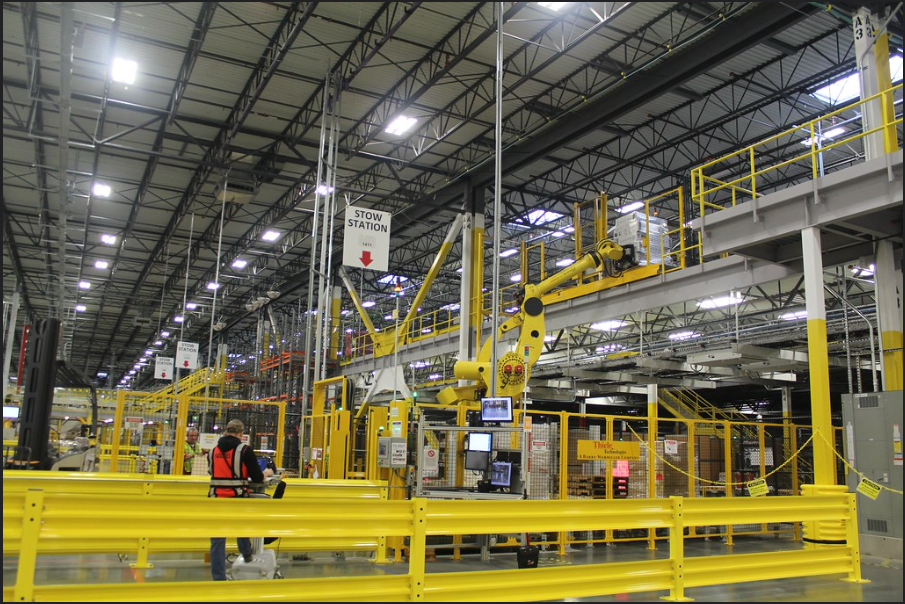 Kiva System robots moving products in DuPont's Amazon fulfillment center. Source: Flickr
Several leading companies demonstrate how smart warehousing technologies are reshaping large-scale logistics. Amazon's fulfillment centers serve as a prominent example, employing mobile robotics, ML algorithms and real-time inventory systems to increase speed and reduce manual labor. The Kiva robots used in these facilities transport entire shelving units to stationary human workers, significantly decreasing walking time and improving picking efficiency. These systems support rapid order processing while maximizing storage density.
In the grocery sector, Ocado has developed one of the most advanced automated fulfillment models. Its warehouses operate on a grid-based system, where hundreds of autonomous robots retrieve items from stacked bins and deliver them to packing stations. The system enables high-throughput order fulfillment, precise inventory control and real-time scheduling — factors that are especially critical for perishable goods and just-in-time delivery models.
Global logistics providers such as DHL and FedEx have also integrated smart technologies into select facilities. DHL has adopted AI-driven parcel sorting, wearable technology for real-time task optimization and autonomous vehicles for internal transport. FedEx has piloted the use of robotic arms, computer vision-based scanning systems and automated labeling to improve package handling efficiency and reduce operational bottlenecks.
These implementations highlight how smart warehouse solutions are being tailored to different logistics contexts, from high-volume e-commerce to time-sensitive food distribution and global parcel networks.
Challenges and limitations
Smart warehouses require substantial upfront investment in automation hardware, infrastructure and software. For small and mid-sized businesses, the return on investment may be slow or uncertain. Automation can also displace manual roles, making workforce reskilling essential. System integration introduces cybersecurity risks and technical complexity, particularly when combining diverse platforms and equipment. Ongoing support and compatibility management are critical for stable operations.
Future trends
Smart warehousing will advance alongside broader logistics innovations. Autonomous delivery systems, including drones and self-driving vehicles, are expected to extend warehouse efficiency beyond the facility itself. Predictive analytics will enable proactive inventory positioning, improving responsiveness to demand. Sustainability will influence future designs through energy-efficient systems, smart climate control and layout optimization to reduce environmental impact and operating costs.