Sound waves separate viruses from saliva
Marie Donlon | September 25, 2024Researchers from Duke University have developed an approach that employs sound waves as acoustic tweezers to isolate viruses from biological samples like saliva.
Isolating viruses from biological samples for close examination, the researchers explained, is key to developing antiviral therapeutics and vaccines for assorted diseases. Isolating, identifying and genetically sequencing a virus offers scientists information about how it causes disease and, consequently, how to create effective therapeutics.
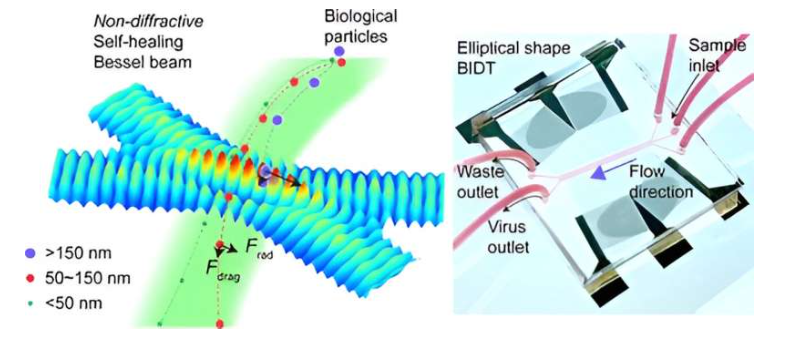 Source: ACS Nano (2024). DOI: 10.1021/acsnano.4c09692
As such, the team determined that their approach could quickly and accurately separate viruses from both large and small particles in human saliva samples.
Current methods for isolating viruses from other particles in biological samples include processes like ultracentrifugation and cell culture procedures, both of which are time consuming.
To expedite the process, the team turned to acoustofluidics, which is a technology that employs sound waves to separate particles by size in a liquid. The team selected a specific type of sound wave, dubbed a Bessel beam, which can reportedly be tuned to sort specific nanosized particles, while multiple waves remain focused over long distances, similar to a pair of tweezers.
The Bessel beam excitation separation technology (BEST) platform features a rectangular chip with a sample-loading inlet at one end and separate virus and waste outlets at the other end. Two acoustic Bessel beams can be applied across the chip, perpendicular to the sample flow.
By tuning the wavelengths of the beams, the system can sort particles of different sizes into different categories wherein particles larger than 150 nm in diameter were trapped on the chip and particles smaller than 50 nm were expelled via the waste outlet. Viruses between 50 nm and 150 nm in size were captured in the virus outlet.
Testing the BEST platform on human saliva samples loaded with SARS-CoV-2, the team determined that the liquid collected from the chip's virus outlet contained 90% of viral genetic material, while the liquid from the waste outlet featured no viral genetic material. This demonstrated, the researchers explained, that the platform successfully isolated the virus and they eventually confirmed their results using electron microscopy, finding viruses only in liquid sampled from the virus outlet.
An article detailing the BEST platform, “Acoustofluidic Virus Isolation via Bessel Beam Excitation Separation Technology,” appears in the journal ACS Nano.