Fighting antibiotic-resistant biofilms with silver nanoparticles
Marie Donlon | September 20, 2024Researchers at Okinawa Institute of Science and Technology (OIST) and the National Institute of Advanced Industrial Science and Technology (AIST) are working to develop a solution for treating antibiotic resistant bacteria biofilms.
To penetrate such biofilms, which are dense, layered colonies that shield bacteria from immune cells and subsequently reduce the effectiveness of antiseptics and antibiotics, the team developed a nanoparticle that combines various mechanisms for killing bacteria.
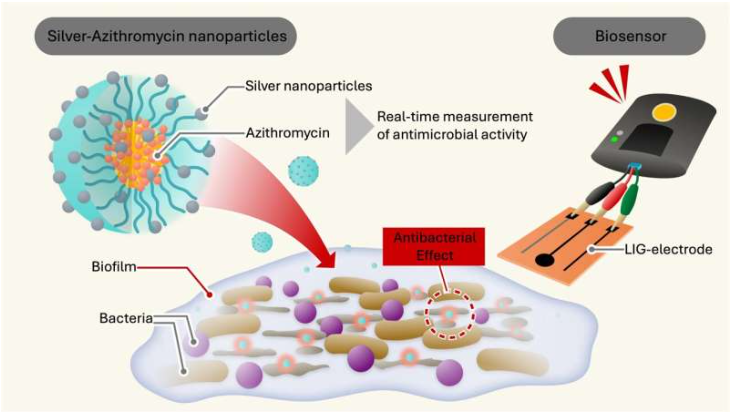 Source: AIST
To accomplish this, the team enveloped silver particles within a polymer shell of Soluplus infused with azithromycin, which is an antibiotic.
To test the effectiveness of the nanoparticles, the team selected bacteria associated with hospital-acquired infections — Escherichia coli and Staphylococcus epidermidis, both of which commonly form resilient biofilms on surfaces including catheters and surgical implants, leading to the development treatment-resistant infections inside the human body.
The new nanoparticles can, unlike traditional antibiotics, deliver a so-called “dual-action attack,” targeting bacterial cells with both antibiotic and silver ions. The researchers note that the encapsulating polymer stabilizes and prevents the nanoparticles from clumping, thereby enhancing their effectiveness. This combination of silver, antibiotics and polymer gave the nanoparticles the ability to both penetrate and disrupt bacterial biofilms.
To determine how the nanoparticles disrupted the biofilms, the researchers used scanning electron microscopy and optical density measurements — methods that are both time-consuming and that require samples to be stained with special dyes. To expedite such measurements, the team developed laser-induced graphene (LIG) electrodes. These miniaturized, highly sensitive LIG electrodes can reportedly allow for the real-time monitoring of bacterial activity, with their large surface areas that offer bacteria a base to form biofilms. Further, they are highly conductive so that they can measure the flow of electrical charges easily.
The researchers explained that because decaying bacteria create a different electrochemical signal than intact bacteria, the electrode detects the bacteria cell's breakdown as the electrical current changes — a method that is faster, more accurate and that works without staining the bacteria.
The approach is detailed in the article, “Enhanced antibacterial efficacy: rapid analysis of silver-decorated azithromycin-infused Soluplus nanoparticles against E. coli and S. epidermidis biofilms,” which appears in the journal Nanoscale.