Video: This autonomous agent assists in the lab
S. Himmelstein | January 25, 2024Any research laboratory would welcome an assistant who can efficiently design and conduct experiments and analyze complex chemical reactions. With the help of large language models (LLMs), including the new GTP-4 version developed by OpenAI, such an industrious worker has been engineered by researchers from Emerald Cloud Lab (California) and Carnegie Mellon University.
Coscientist can autonomously design, code and carry out several reactions, and has been demonstrated to robotically produce compounds including paracetamol and aspirin in a wet lab. The system uses LLMs to absorb instruction manuals on the internet and identify the best kit and reagents in its toolkit to make a desired molecule.
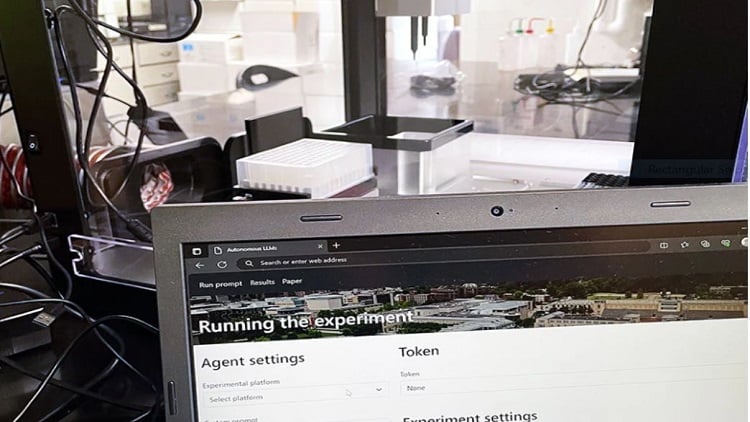 Coscientist uses an LLM to run robotic laboratory equipment. Source: Carnegie Mellon University
As reported in Nature, Coscientist was prompted to plan a synthesis for several known molecules, including the painkillers paracetamol and aspirin, and the organic molecules nitroaniline and phenolphthalein. In the planning stage, Coscientist was able to work out the steps that would deliver the best reaction yields overall, and it produced the molecules correctly. When prompted to execute a Suzuki–Miyaura coupling reaction, which forms the carbon-carbon bonds essential in drug discovery, the system performed perfectly.
Since Coscientist demonstrates advanced reasoning and experimental design capabilities, the researchers anticipate that such artificial intelligence-assisted systems will be valued as a solution that can bridge the gap between the need to accelerate pharmaceutical and materials discovery and the fact that trained scientists are in short supply.