Evaluating insulation materials for LNG piping and equipment
July 23, 2026Managing heat gain, moisture intrusion and long-term system performance
Liquefied natural gas (LNG) facilities operate in one of the most demanding thermal environments found in industrial processing. Storage tanks, transfer lines, valves, fittings and process equipment routinely operate at temperatures approaching -260° F (-162° C), creating significant challenges for insulation system designers.
The primary objective of a cryogenic insulation system is to minimize heat ingress into the process. Even relatively small amounts of heat transfer can contribute to increased boil-off gas (BOG), reduced process efficiency, higher operating costs and potential reliability concerns. In addition, insulation systems must prevent condensation and ice formation, resist long-term moisture intrusion, withstand thermal cycling and maintain mechanical integrity throughout the life of the facility.
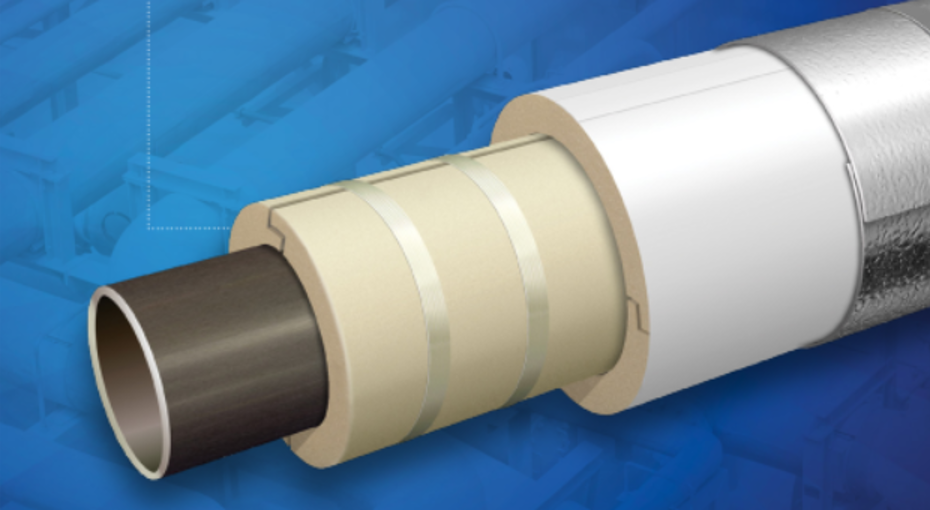 Figure 1: Cryogenic insulation systems play a pivotal role in various industries. Source: Johns Manville
As LNG infrastructure continues to expand globally, insulation selection has become an increasingly important design decision affecting both capital investment and long-term operating economics.
Key functions of cryogenic insulation systems
Effective cryogenic insulation serves several critical functions in LNG applications:
- Minimizes heat transfer into cryogenic process systems
- Reduces BOG generation
- Prevents surface condensation and ice formation
- Protects personnel from exposure to extreme temperatures
- Enhances energy efficiency
- Maintains process stability and reliability
- Supports long-term asset performance
Failure to adequately address any of these requirements can result in increased maintenance costs, reduced operational efficiency and unplanned downtime.
Material selection factors for LNG applications
Selecting insulation for cryogenic service requires evaluation of multiple performance characteristics rather than focusing on a single property.
Thermal conductivity
Thermal conductivity is often the primary performance criterion because it directly affects heat ingress and overall insulation thickness requirements.
Lower thermal conductivity values allow designers to achieve target thermal resistance with less material thickness, which may reduce overall system weight and simplify installation in congested process areas.
Moisture resistance
Moisture intrusion remains one of the most significant threats to long-term cryogenic insulation performance.
When water penetrates an insulation system, thermal performance deteriorates and the risk of corrosion under insulation (CUI) increases. Therefore, insulation materials with closed-cell structures and low water absorption characteristics are frequently preferred for long-term cryogenic service.
Mechanical performance
Cryogenic systems are regularly subjected to thermal contraction, vibration, mechanical loading and maintenance activities.
Insulation materials must maintain dimensional stability and structural integrity while accommodating these operating conditions throughout the system lifecycle.
Installation efficiency
Installation labor can represent a significant portion of the total installed cost of an insulation system.
Factors including material weight, number of joints, fabrication requirements and accessory materials all influence project schedules and labor productivity.
Common insulation materials used in LNG facilities
Several insulation technologies are commonly specified for LNG applications, including cellular glass, silica aerogel and polyisocyanurate (PIR).
Cellular glass
Cellular glass has a long history in cryogenic service due to its noncombustible composition and moisture resistance.
However, its relatively high density can increase structural loading on piping and support systems. In addition, shorter section lengths may increase the number of joints requiring sealing during installation.
Silica aerogel
Aerogel-based insulation systems offer very low thermal conductivity and are often considered for applications where space is limited.
However, achieving required thermal resistance may involve multiple installed layers, increasing fabrication complexity, installation time and accessory material requirements.
Polyisocyanurate (PIR)
Polyisocyanurate insulation has gained increasing attention for LNG applications due to its combination of thermal performance, low weight, moisture resistance and installation efficiency.
Modern PIR insulation systems are engineered specifically for cryogenic environments and are used extensively on LNG piping, equipment, vessels and process systems.
Evaluating PIR insulation for LNG service
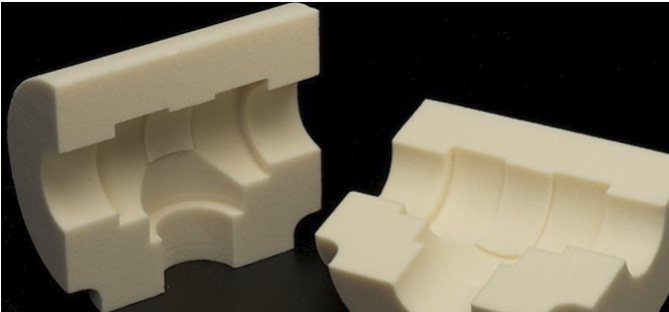 Figure 2: cryogenic insulation systems are essential for preventing surface condensation on industrial piping and equipment. Source: Johns Manville
Polyisocyanurate insulation systems such as TRYMER PIR provide several characteristics that engineers may consider when evaluating cryogenic insulation alternatives.
1. Superior thermal performance
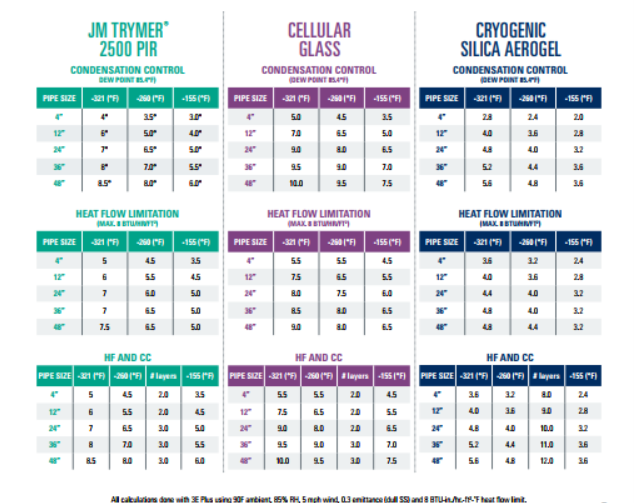
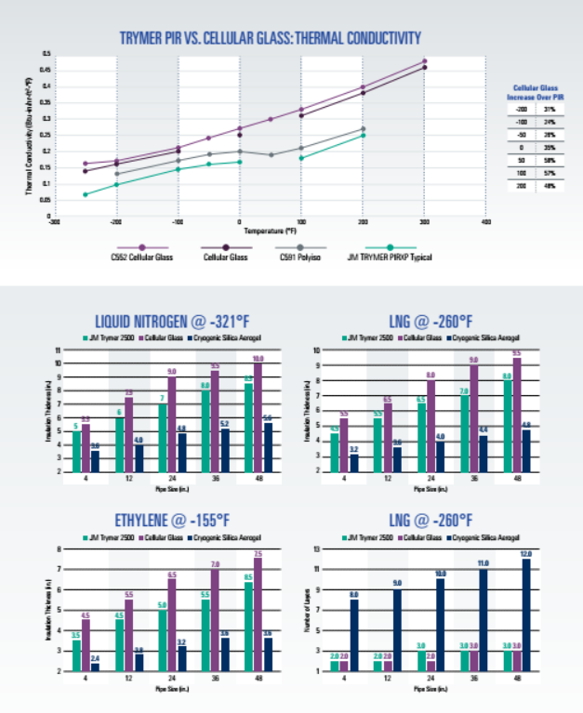
• Lower k-factor: Up to 25% better thermal conductivity than cellular glass at LNG temperatures (~ -265° F).
• Thinner profiles: Achieve required thermal resistance with 18% to 40% less thickness, reducing system bulk and improving space efficiency.
• Closed-cell structure resists moisture ingress, maintaining insulation integrity over decades. Open cell aerogel will readily absorb moisture should the vapor retarder become damaged.
2. Lightweight and strong
• 65% lighter than cellular glass — reduces load on pipe supports and structural systems.
• At a density of 10 pcf, aerogel blankets are four times the weight per square foot of insulation. Even at 31% to 37% thinner, aerogel will still be 2.5 to 2.8 times heavier.
• No need for anti-abrasive coatings on vibrating equipment.
3. Faster, easier installation
• Longer standard lengths (36 inches versus 24 inches for cellular glass) means 50% fewer joints — less labor, fewer potential leak paths.
• With four to eight more layers for 10 mm aerogel than Trymer, aerogel requires increased labor (shop or on site) to cut the layers to length.
This also increases the accessory materials needed to secure all the additional layers.
• Minimal PPE requirements — no lost efficiency due to installers suiting up and down.
4. Lower total installed cost
• One significant economic consideration in cryogenic systems is the cost associated with LNG boil-off in an LNG plant. BOG occurs naturally due to heat ingress, even with the best insulation. In an LNG plant, the boil-off rate can be around 0.1% to 0.25% of the total LNG volume per day. This boil-off represents a loss of valuable LNG, which can translate into millions of dollars in lost revenue annually. Efficient cryogenic insulation systems can significantly reduce these substantial economic costs by minimizing boil-off.
• Material cost per board foot of Trymer is typically less than cellular glass. With Trymer being 20% to 40% thinner, the material cost per linear foot of pipe will be about one quarter to one third the cost.
• Comparing similar material costs for 1 inch of Trymer and 1 inch of silica aerogel (for a 12 inch x 12 inch sample), aerogel material cost is likely to be over 10 times higher.
• Fewer accessories required: less jacketing, sealant and vapor barrier material.
• Typically involves reduced labor hours and simplified fabrication — ideal for both shop and field installation.
The relationship between insulation performance and LNG boil-off
One of the most important economic considerations for LNG facilities is boil-off gas generation.
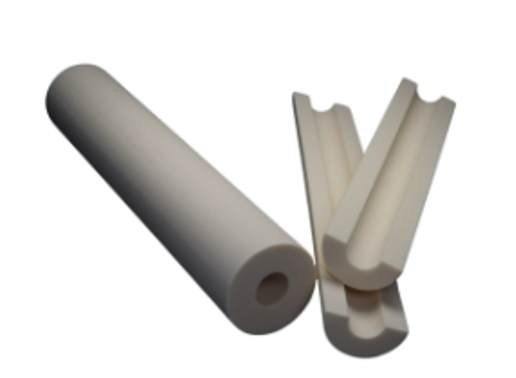 Figure 3: Efficient cryogenic insulation systems can significantly reduce substantial economic costs by minimizing boil-off. Source: Johns Manville
Heat entering storage and transfer systems causes a portion of the LNG to vaporize. Although some amount of boil-off is unavoidable, insulation performance plays a direct role in limiting heat ingress and reducing losses.
For operators managing large LNG inventories, even incremental improvements in thermal performance can generate meaningful economic benefits over the operational life of a facility.
Insulation selection should therefore be evaluated not only on initial material cost but also on its contribution to:
- Energy efficiency
- Boil-off reduction
- Maintenance requirements
- Asset reliability
- Lifecycle operating costs
This broader lifecycle perspective often provides a more accurate assessment of insulation system value.
Designing for long-term reliability
Successful LNG insulation systems require careful consideration of:
- Operating temperature range
- Thermal conductivity performance
- Mechanical strength
- Moisture resistance
- Installation quality
- Vapor barrier design
- Maintenance accessibility
- Total lifecycle cost
Material selection should ultimately align with project-specific operating conditions, environmental exposure and performance expectations.
LNG facilities present unique thermal and mechanical challenges that require carefully engineered insulation solutions. As operators seek to improve efficiency, reduce boil-off losses and extend asset life, insulation selection remains a critical design decision.
Polyisocyanurate insulation systems such as TRYMER PIR represent one option for addressing these requirements through a combination of thermal efficiency, moisture resistance, lightweight construction and installation advantages. When evaluated alongside project-specific performance requirements, PIR insulation can provide an effective solution for modern LNG infrastructure.
Connect with a technical specialist
Selecting insulation for LNG facilities requires balancing thermal performance, moisture resistance, mechanical durability, installation efficiency and lifecycle cost. Project-specific operating conditions often influence the optimal insulation strategy.
For additional technical information or to schedule an engineering-focused presentation on cryogenic insulation systems and LNG applications, visit the Johns Manville website.
About Johns Manville

Johns Manville, a Berkshire Hathaway company, is a leading manufacturer and marketer of premium-quality products for building insulation, mechanical insulation, industrial insulation, commercial roofing and roof insulation, as well as fibers and nonwovens for commercial, industrial and residential applications.