Two-way Oxide Catalyst Is Developed
Engineering360 News Desk | June 08, 2016For most catalysts, driving chemical reactions is a one-way street. That’s because they’re good at moving reactions along in one direction but poor at driving them in the opposite direction. Now, researchers led by the U.S. Department of Energy's Oak Ridge National Laboratory have created a high-performance, two-way oxide catalyst and filed a patent application for its invention.
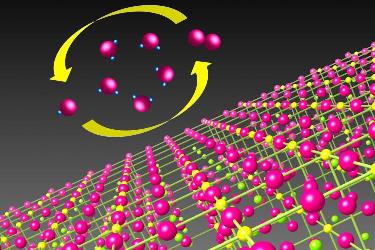 Illustration depicts oxygen atoms (pink) and hydrogen (blue) in oxygen reduction and evolution reactions that transfer electrons between two species and convert oxygen molecules to hydroxide ions and vice versa. Source: Ho Nyung Lee, ORNLThe discovery may aid development of new material systems for electrochemistry. Fuel cells, rechargeable batteries and similar energy storage devices convert chemical energy into electricity through a chemical reaction. Catalysts accelerate this process, making it more efficient.
An oxygen reduction catalyst, for example, extracts electrons from oxygen molecules, while an oxygen evolution catalyst drives the reaction in the opposite direction. Catalytic reactions that proceed in both directions are required for charging and discharging regenerative energy storage devices.
Oxide materials are the workhorses of energy generation and storage. Several oxide materials contain transition metals, which can easily exchange electrons. Previous studies have shown that straining of oxide thin films improves their ability to conduct ions. Less is known about how strain affects catalysis in oxide thin films.
For their research, scientists studied lanthanum nickelate, an oxide system with an electronic structure that can facilitate peak catalytic performance. They examined how strained layers of the oxide perform as a bifunctional catalyst.
The researchers made a thin film of lanthanum nickelate through heteroepitaxy, which grows one material on a substrate with different lattice spacing. The lattice mismatches introduce strain into the system. The strain changed the film’s electronic structure without altering its chemical composition, creating what the researchers say is a catalyst that is better at driving chemical reactions than other materials, including platinum.