Automated route to pharma compound production
S. Himmelstein | December 10, 2021A new method to automate the production of small molecules suitable for pharmaceutical application can potentially be used for molecules that are typically produced via manual processes, thereby reducing the manpower required.
The process developed at the National University of Singapore (NUS) combines two chemical synthesis techniques: continuous-flow synthesis, where chemical reactions proceed in a seamless process, and solid-supported synthesis, in which molecules are chemically bonded and grown onto an insoluble support material. The resulting solid phase synthesis-flow (SPS-flow) scheme enables development of target molecules on a solid supporting material as the reaction reagent flows through a packed-bed reactor in a system controlled by computer automation. Compared to existing automated techniques, the SPS-flow method enables wider reaction patterns and longer linear end-to-end automated synthesis of pharmaceutical compounds.
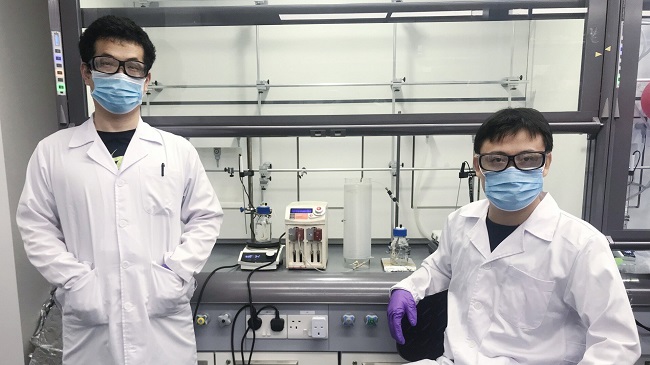 A new automated technique eliminates the tedious multistep procedures inherent to manual synthesis of pharmaceutical compounds. Source: NUS
When applied to the production of prexersatib, a pharmaceutical molecule used in cancer treatment, the researchers demonstrated a fully automated six-step synthesis with 65% isolated yield within 32 hours. Existing production protocols are estimated to require a week and an extensive six-step manual process and purification procedure to realize a yield of up to 50%. The automated SPS-flow method also produced 23 prexasertib derivatives, indicating its potential for drug discovery and design.
The researchers plan to continue developing the system described in Nature Chemistry in pursuit of a fully automated and portable system for active pharmaceutical ingredient production at a larger scale suitable for manufacturing.