Tests Confirm Viability of Lithium-Air Battery
Engineering360 News Desk | February 11, 2016Researchers at the University of Illinois at Chicago (UIC) have helped prove that a prototype lithium-air battery developed at the U.S. Department of Energy’s Argonne National Laboratory (ANL) produces lithium’s superoxide as it discharges. The test underscores the battery's potential to have a high efficiency and good cycle life.
Lithium-air batteries (in which the metallic lithium of the anode reacts with oxygen from the air) hold the promise of storing electricity at up to five times the energy density of lithium-ion batteries, but they have inherent shortcomings. Specifically, versions tested to date have stored and released energy from lithium peroxide, an insoluble substance that clogs the battery’s electrode.
ANL battery scientists developed a prototype that they claimed had the ability to produce only lithium’s superoxide, not peroxide, as the battery discharges. Lithium superoxide breaks down into lithium and oxygen, thus offering the possibility of a high-efficiency, long-life battery. The Argonne group designed the battery to consume one electron rather than two and produce the superoxide, says UIC’s Amin Salehi-Khojin, assistant professor of mechanical and industrial engineering. But it was difficult to prove that the reaction took place.
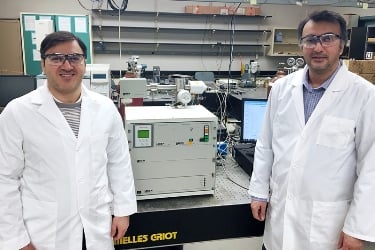 Mohammad Asadi (left) and Amin Salehi-Khojin with their differential electrochemical mass spectrometry instrument. Image credit: UIC College of Engineering. Salehi-Khojin and postdoctoral research associate Mohammad Asadi devised a mass spectroscopy apparatus to measure the electrochemical reaction products in situ during battery charging or discharging. The system operates in an ultra-high vacuum and is “very sensitive to the tiniest change in oxygen concentration,” says Asadi.
The UIC researchers demonstrated that one electron per oxygen atom was produced, indicating lithium superoxide, not peroxide, was forming in the battery. They also were able to show that no other lithium compounds were generated as by-products.
“Not only can we analyze the products of the electrochemical reaction, we can elucidate the reaction pathway," says Salehi-Khojin. "If we know the reaction pathway, we’ll know how to design the next generation of that battery for energy efficiency and cost effectiveness.”