Drones featuring inflatable frames could enhance search and rescue missions
Marie Donlon | April 25, 2023Researchers from Arizona State University have developed a drone featuring an inflatable frame that enables it to be used to navigate through collapsed buildings and other narrow spaces following disasters.
Because drones tend to be hard-bodied, tasks such as search and rescue missions are complicated by collision risks with structures — posts, beams, pipes or cables — that could ultimately destroy them.
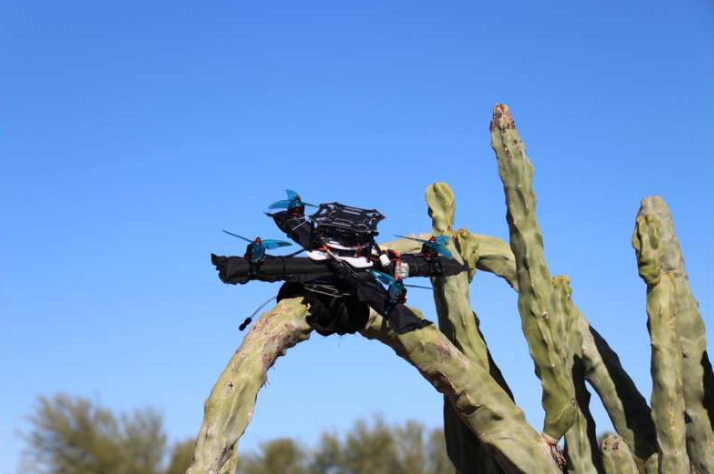 Source: University of Arizona
To better endure such collisions and enable the drones to appropriately conduct search and rescue operations, the team developed a first-of-its-kind quadrotor drone featuring an inflatable frame. According to its developers, the stiffness of the new drone is tunable or adjustable, which enables it to absorb and recover from unexpected collisions. The new design also reportedly achieves the material compliance necessary to enable the drone to perch on virtually any surface.
Considered an example of controlled collision, perching is achieved through the use of soft tissues, which absorb the force of impact. To accomplish this, the team designed a hybrid fabric-based bistable grasper for the drone.
"It can perch on pretty much anything. Also, the bistable material means it doesn't need an actuator to provide power to hold its perch. It just closes and stays like that without consuming any energy," the researchers explained. "Then when needed, the gripper can be pneumatically retracted and the drone can just take off."
The device with the inflatable frame can lead to an increased use of drones in search and rescue operations, as well as for other applications including the monitoring of forest fires, assisting military reconnaissance and exploring the surface of other planets.
An article detailing the drone, “A Soft-Bodied Aerial Robot for Collision Resilience and Contact-Reactive Perching,” appears in the journal Soft Robotics.
For more on the drone with the inflatable frame and perching capability, watch the accompanying video that appears courtesy of Arizona State University.