Mass spectrometer to fly for NASA
S. Himmelstein | March 27, 2023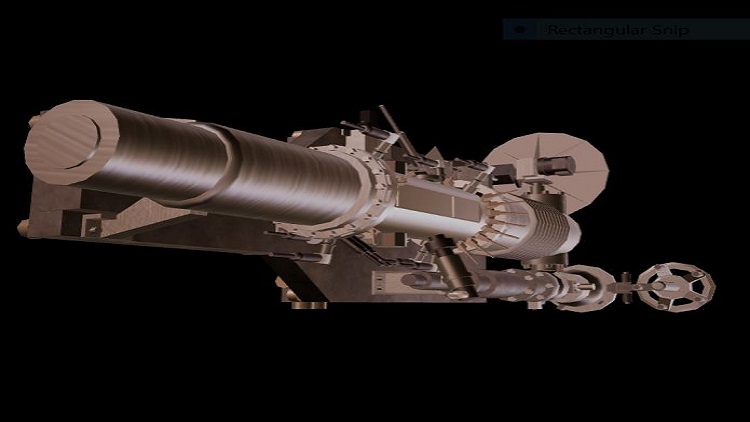 A model of MASPEX. Source: NASA
When NASA’s Europa Clipper spacecraft launches in 2024, the mission will bring a new mass spectrometer to the Jovian system to determine if the moon can support life. The MAss Spectrometer for Planetary EXploration (MASPEX) instrument engineered at the U.S. Southwest Research Institute (SwRI) will analyze the gases near Europa to understand the chemistry of its surface, atmosphere and suspected subsurface ocean.
On arrival at its destination by 2030, MASPEX will also be deployed to examine how Jupiter’s radiation alters Europa’s surface compounds and how its icy surface and subsurface ocean exchange material. Gas molecules collected by MASPEX are converted into positively charged ions and bounced up to 400 times back and forth within the instrument. By timing their transit, MASPEX measures the mass of the ions to reveal each molecule’s identity and provide clues as to whether Europa is habitable.
“We hope to identify and fly through plumes and other sources of gas venting from cracks in Europa’s icy surface,” said SwRI’s Dr. Christopher Glein, MASPEX co-investigator and a planetary geochemist. “We know microbes on Earth exploit any molecule that can serve as a food source. MASPEX is going to help Europa Clipper determine whether there is anything for microbes to eat, such as organic molecules that might be sourced from hydrothermal vents at the bottom of a deep ocean. The data from this exciting mission will give us a much richer perspective on the habitability of Europa.”