What Lives Beneath: Characterizing Creatures in the Deep Biosphere
S. Himmelstein | December 12, 2018About 70% of Earth's bacteria and archaea — a domain of single-celled microorganisms — live underground. To shed light on the nature of these microbes and implications for the deep carbon cycle, the Deep Carbon Observatory (DCO) was launched in 2009 as an international collaboration. A decade of research has improved 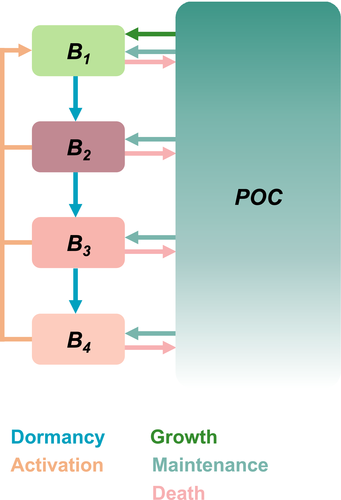 A conceptual model showing state variable components (boxes) and transfers among them (arrows). The state variables B1 to B4 refer to pools of biomass that are distinguished by their physiological state; POC refers to particulate organic carbon. The arrows are color-coded according to the processes that increase or decrease the amount of carbon in each reservoir. Source: University of Southern Californiaour understanding of the deep biosphere extending several kilometers beneath Earth’s surface.
Data generated by drilling 2.5 km into the seafloor and sampling microbes from continental mines and boreholes more than 5 km deep were used to construct models of this subterranean ecosystem. The researchers have approximated the size of the deep biosphere — 2 to 2.3 billion cubic km (almost twice the volume of all oceans). The carbon mass of deep life is estimated to be 15 to 23 billion tons, an average of at least 7.5 tons of carbon per cu km subsurface. They estimate that 200 to 600 octillion microbes, or 2 to 6x1029 cells, live in the continental subsurface.
Deep microbes are often very different from their surface counterparts, with life cycles on near-geologic timescales and subsisting in some cases on nothing more than energy from rocks. The genetic diversity of life below the surface is comparable to or exceeds that above the surface, and some genera exist planet-wide.
Microbial community richness relates to the age of marine sediments where cells are found, indicating that food energy in older sediments has declined over time, reducing the microbial community.
A candidate for Earth’s hottest organism in the natural world is Geogemma barossii, a single-celled organism living in hydrothermal vents on the seafloor. Its cells, tiny microscopic spheres, grow and replicate at 121° C (250° F). The record depth at which life was observed in the continental subsurface is approximately 5 km; the record in marine waters is 10.5 km from the ocean surface, a depth of extreme pressure.
DCO researchers affiliated with University of Southern California contributed to this study, which is published in Geobiology.