Listen to a Martian dust devil
S. Himmelstein | December 20, 2022The formation of dust devils is common in some regions of Mars, and scientists hope to obtain a better understanding of the planet’s climate and atmospheric conditions by studying these short-lived whirlwinds. An audio recording of such an event captured by the NASA Perseverance rover on September 27, 2021, can now provide researchers with quantitative information on the dust devil’s structure and behavior.
As reported in Nature Communications, an international research team analyzed audio from the rover’s SuperCam microphone in addition to data recorded by the craft’s navigation camera and its Mars Environmental Dynamics Analyzer (MEDA) instrument sensors. The evaluation of these data, in combination with atmospheric modeling, has resulted in estimated dust devil dimensions of 82 ft (25 m) wide and at least 387 ft (118 m) tall. This system was also determined to be moving at about 12 mph (19 kph).
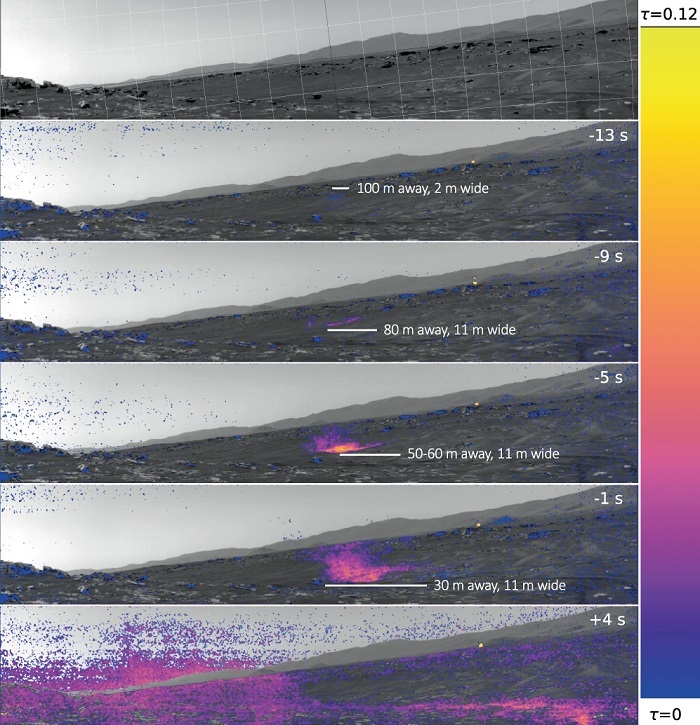 Images from the navigation camera. The density of dust is indicated by color, going from blue (lower density) through purple to yellow (highest density). Source: Nat Commun 13, 7505 (2022)
The Perseverance rover has posted many important accomplishments since its touchdown on February 18, 2021. The journey of a Martian moon across the face of the sun was filmed in April 2022, and a first rock drill sample was collected in September 2022 for eventual delivery to Earth.
Scientists from Universidad del País Vasco (Spain), University of Toulouse (France), University of Michigan, Space Science Institute (Colorado), Johns Hopkins Applied Physics Laboratory, Instituto Nacional de Técnica Aeroespacial (Spain), Centro de Astrobiología (Spain), U.S. Los Alamos National Laboratory, California Institute of Technology/Jet Propulsion Laboratory, Aeolis Research (Arizona), NASA AMES Research Center, Sorbonne Université (France) and Purdue University participated in this research.