An interactive periodic table of isotopes
S. Himmelstein | October 31, 2022An interactive periodic table of isotopes provides information about any isotope, such as the number of protons and neutrons, whether it is stable or radioactive, its natural abundance on Earth, and its uses.
Developed by students from the University of South Carolina-Aiken, the Interactive Isotopes App can be accessed on- or offline and is available for desktops and mobile devices. Clicking on an element pulls up specific information that includes images and facts about the uses for its different isotopes. In the absence of known uses, a brief history about the element is provided.
A nuclide graph that displays all the isotopes of the chemical element is also shown on the main screen for the element selected. In exploring the graph, users can see every known isotope and its position relative to the line of stability, where isotopes have the most balanced ratios of protons to neutrons. Radioactive isotopes emit radiation as they rearrange their nucleus in order to become more stable, getting closer to the line of stability over time.
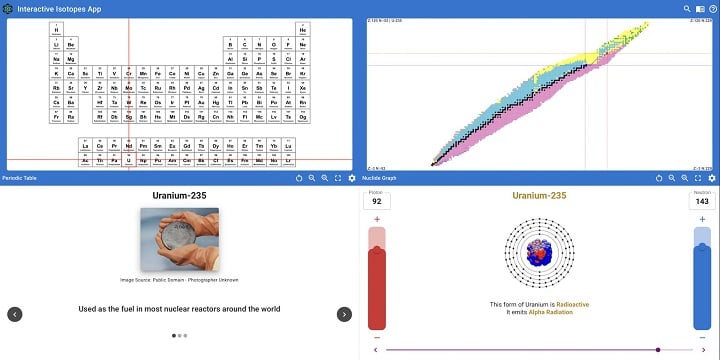 A screen shot of the app depicting U-235 and its decay chain. Source: American Nuclear Society
After an element is selected, two vertical bars appear in a window that allow the user to change the number of protons and neutrons. Adding or subtracting neutrons moves only the nuclide graph, since the atomic number remains the same. Adding or subtracting protons also shifts both the nuclide graph and the position on the periodic table. If the isotope selected is radioactive, the decay chain is visible in the nuclide graph, such as that for uranium 235 (U-235), the highly radioactive fissile isotope used in nuclear reactors. Using the dials on the app to enter 92 protons and 143 neutrons will reveal the decay chain for U-235.