Recyclable glue delivers fast, durable underwater bonds
Marie Donlon | August 17, 2026A team from China has developed a superglue capable of repelling water and forging a strong and recyclable bond in mere minutes.
As most glues tend to require a dry surface to effectively adhere, bonding materials underwater presents a challenge. Water forms a thin film on surfaces, so the adhesive doesn't touch the material directly — it touches a layer of water, weakening the bond.
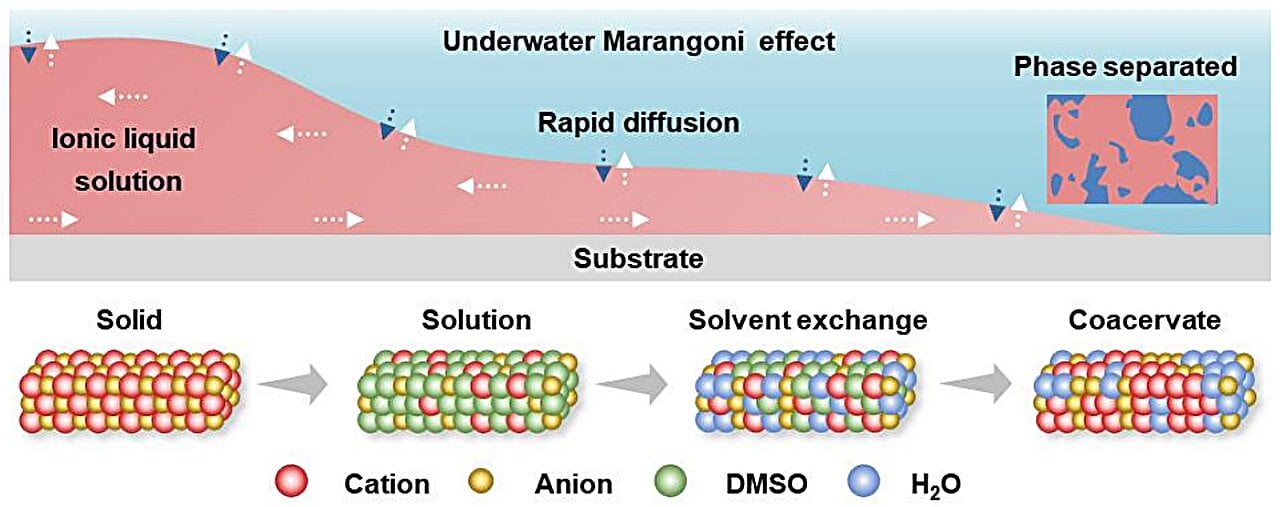 Source: Nature Communications (2026). DOI: 10.1038/s41467-026-76507-2
As such, the team created their so-called superglue by blending a supramolecular ionic liquid — which is a salt-like material whose molecules are held together by temporary, reversible interactions — with a solvent called dimethyl sulfoxide (DMSO). Once blended the solution was then applied onto submerged objects composed of ceramic, copper, epoxy resin and polyamide.
The team explained that once the solution encounters an underwater surface, surface tension differences provoke a rapid motion called Marangoni flow that disturbs the thin layer of water on the surface of the object. The DMSO solvent then diffuses outward, enabling the molecules to instantly reassemble into a tough, water-resistant adhesive within seconds.
"Marangoni flow not only speeds up supramolecular aggregation but also effectively penetrates hydration layers," the team noted.
The adhesive, dubbed BP16TPB, reportedly achieved a bonding strength of 1.1 megapascals on ceramic after just 10 seconds, rising to 1.3 megapascals within five minutes. Making this possible is the adhesive’s unique self-assembly process. As the solvent evaporates, the molecules create a network of temporary bonds that fortify the material.
During long-term trials of the adhesive, the team applied BP16TPB to a joint, which held a 4.4 lb weight underwater for over three years without failing. Further, the adhesive also created strong bonds with copper, epoxy resin and polyamide in acidic, alkaline and salty water.
Finally, the team discovered that the glue is also reusable by dissolving it back into the DMSO solvent, which restored it to its liquid state and subsequently reapplied it to stick new surfaces together. This part of the experiment was conducted up to eight times with the glue demonstrating no observable reduction in adhesion performance.
Before being ready for market, the team is expected to address at least one challenge: the adhesive performance drops dramatically in applications reaching more than 158° F. However, once it is available, it promises to be appropriate for applications such as the repair and maintenance of ships and offshore platforms, sealing leaking underwater pipelines and attaching environmental sensors to ocean structures.
An article detailing the adhesive, “Macroscopic assembly of supramolecular coacervates for underwater adhesion,” appears in the journal Nature Communications.