New mask can diagnose wearers with COVID-19
Marie Donlon | June 29, 2021A team of engineers from Massachusetts Institute of Technology (MIT) and Harvard University have developed a new face mask that diagnoses the wearer with COVID-19 in just an hour and a half.
To diagnose the wearer with COVID-19, the mask features embedded freeze-dried synthetic biology sensors that detect viral and bacterial nucleic acids, along with nerve toxins and toxic chemicals.
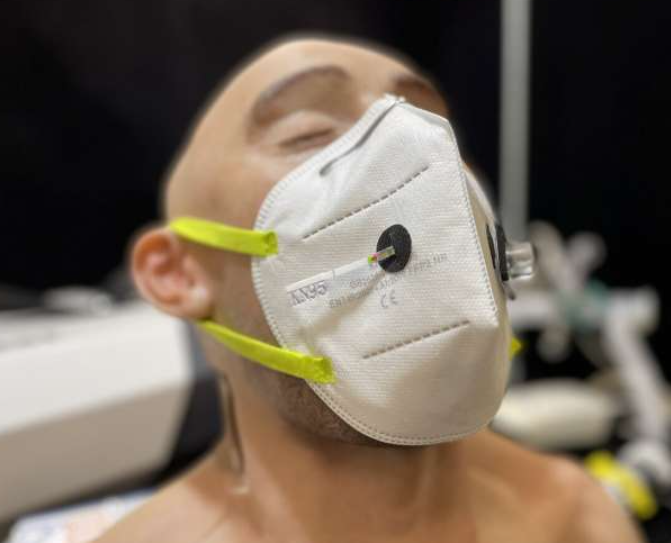 Source: Wyss Institute at Harvard UniversityThose freeze-dried components were embedded into a section of synthetic fabric, surrounded by a ring of silicone elastomer. The prototype mask also features a small reservoir of water that is released with the press of a button, which hydrates the freeze-dried components, thereby mimicking exposure to an infected person, activating the sensors, and triggering a color change or a fluorescent or luminescent signal that can be read by an embedded, wearable spectrometer. The results of the readings, according to researchers, would only be visible to the wearer, thereby preserving the wearer’s privacy.
The mask prototype was tested on wearers with the sensors located on the inside of the mask and proved as sensitive as commonly used polymerase chain reaction (PCR) tests, which detect genetic material from a specific organism, such as a virus. However, the masks can also be designed to feature the sensors on the outside of the mask to monitor environmental exposure to the virus.
Going forward, researchers are working to develop clothing such as lab coats for healthcare professionals featuring the same sensors to demonstrate the range of pathogens healthcare workers encounter and when they encounter them. Likewise, the researchers suggest that the sensors can be swapped out to test for influenza, Ebola and Zika viruses as well.
The research appears in the journal Nature Biotechnology.