Watch: A sweet remedy softens rigid brain implants
S. Himmelstein | June 24, 2021The diversity of brain implant applications to monitor brain activity or treat neurological disorders is somewhat limited by the tendency of these devices to provoke a foreign body response and damage surrounding tissue. A softer alternative to the stiff, rigid nature of these implants responsible for deleterious side-effects has been engineered at McGill University, Canada.
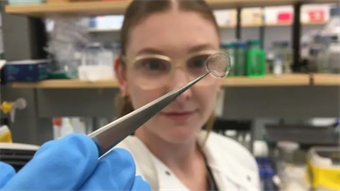
Silicone polymers and sugar are the major ingredients consumed to fabricate 0.2 mm thick implants with a  The soft implant is encased in a dissolvable sugar coating. Source: McGill Universitysoft consistency comparable to that of the brain itself. The silicone implant is formed in dissolvable molds composed of sugar, and the hardened form of the sweet material is then applied to encapsulate the implant into a needle.
Surgically inserted into the brain of an anesthetized rat, the sugar-coated appliance transported the implant to the desired location and dissolved within seconds. The soft implant remains in place as the sugar is naturally metabolized by the brain. Analysis of brain tissue three and nine weeks after implantation revealed higher neuronal density and lower foreign body response compared to traditional implants.
A paper describing the new brain implant material and synthesis process is published in Advanced Materials Technologies.