Miniature implants could be a game changer for the peripheral nervous system
Geert Langereis, program manager for health research, imec; and Vojkan Mihajlovic, principal member of technical staff, Stichting imec Netherlands | June 25, 2025The central (CNS) and peripheral (PNS) nervous systems work together to coordinate and regulate body functions. While the CNS, comprising the brain and spinal cord, processes information and sends instructions, the PNS acts as the communication network, linking the CNS to organs, limbs and tissues. The PNS plays a crucial role in sensory experiences, reflexes and autonomic functions such as digestion and heartbeat, making it an essential component of daily life.
Diseases affecting the PNS disrupt nerve communication, leading to limitations in mobility, sensation and coordination. Traditionally, treatments have relied on drugs tailored to specific conditions, but these often require years of development and approval. Bioelectronic medicine offers a groundbreaking alternative, leveraging electrical pulses to interact directly with the nervous system.
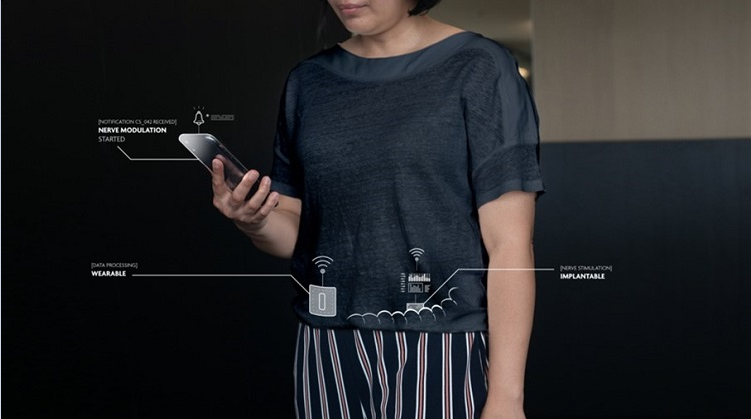 Bio-electronic medicine is a new form of therapy that uses electrical pulses to modulate nerve activity. The small implant delivering the pulses sits in the body, a wearable device delivers power to the implant and a mobile unit can be used to tweak the stimulation parameters. Source: Imec
Electricity as a therapy
Bioelectronic medicine stimulates electrically active tissue such as nerves or muscles to suppress undesired conditions in the body, or to facilitate desired conditions. The best-known example already on the market is the cardiac pacemaker, which stimulates the heart muscle.
The PNS is of particular interest in modern research on bioelectronic medicine because it is the bidirectional highway that carries signals from the brain to the organs and vice versa.
By stimulating the PNS, both the organs and the brain can be addressed. Bioelectronic devices offer unique advantages: they can be instantaneously activated or adjusted by physicians or patients, and their functionality can adapt in real time to health markers or environmental changes. Today, several chronic diseases such as rheumatoid arthritis, chronic pain and epilepsy are targets for this therapy.
Imec employs nanotechnology to develop small, low-power stimulating implants for various PNS applications, building on its expertise with brain implants. Developing effective PNS implants presents several key challenges with achieving precise stimulation emerging as one of the most significant. This article will cover a new stimulation protocol that enables selective activation of specific nerve fibers.
Other challenges that Imec is working on include developing durable encapsulation to maintain reliable implant functionality over months or years, investigating efficient and application-specific powering solutions and creating closed-loop systems. These systems, capable of real-time adjustments based on feedback, are a complex but necessary step toward more adaptive and personalized treatments.
Targeting in the vagus nerve
Targeted stimulation is of particular interest for vagus nerve therapies. Within the PNS, the vagus nerve is a primary target for bioelectronic medicine due to its extensive influence over critical bodily functions.
As the body’s longest cranial nerve, it forms a direct connection between the brain and major organs such as the heart, lungs and digestive system. This unique role makes the vagus nerve an ideal target for interventions, as stimulating a single (and more superficial) point can impact a wide array of physiological processes.
For instance, vagus nerve stimulation (VNS) in the neck is already used to treat treatment-resistant epilepsy and depression, and it shows promise for conditions such as chronic migraine.
Despite its potential, VNS presents significant challenges. The vagus nerve is a complex structure containing sub-bundles (fascicles) with diverse fibers that twist and merge along its length. Accurate stimulation of specific fibers is crucial to avoid side effects such as voice changes, heart palpitations or breathing irregularities — common issues when unintended fibers are affected.
Targeted stimulation translates as focusing the stimulation energy on a smaller physical unit, from millimeters to tens of millimeters.
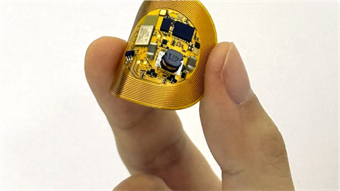
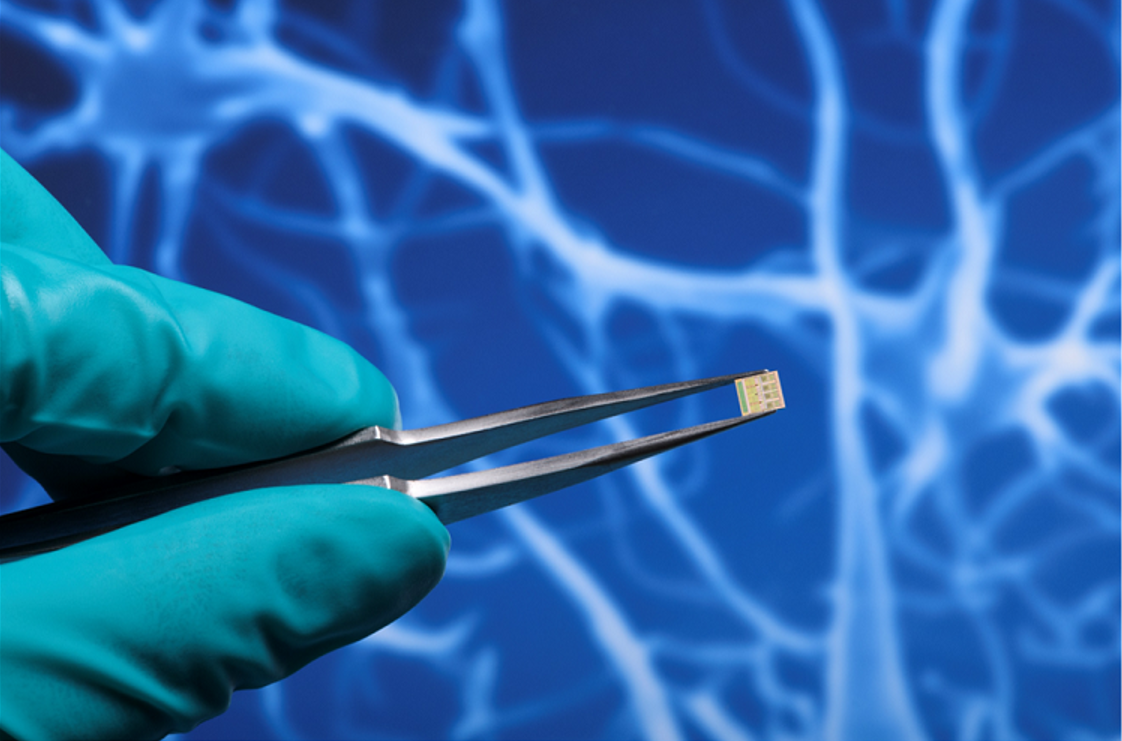 Photo of the chip that enables selective nerve stimulation via intermittent interferential current stimulation (i²CS). Source: Imec
Researchers at Imec and the Feinstein Institute of Medical Research recently introduced a new technique called i2CS (intermittent interferential current stimulation) to radically improve the selectivity of nerve stimulation. i²CS leverages the interference of electric fields of different wavelengths to achieve precise control over the activation of organ-specific fibers within the vagus nerve.
For example, i²CS demonstrated improved selectivity in targeting bronchopulmonary fibers while minimizing undesired effects on laryngeal fibers, which are often intertwined within the same nerve fascicles.
While interferential stimulation has been explored for modulating brain activity, this study is the first comprehensive application of intermittent interferential stimulation in peripheral nerves, particularly the vagus nerve. Using intermittent rather than continuous stimulation not only enhances control but also improves energy efficiency, simplifies integration into implants and allows simultaneous neural activity recording and stimulation. This advancement facilitates the development of closed-loop applications, marking a significant step forward in the field of bioelectronic medicine.
Advanced packaging for implants
Another challenge for PNS devices is to design a package that allows the device to remain in the body for months or years. Proper encapsulation and wiring are of primordial importance for functionality, longevity and stability. The protective barrier works both ways. On the one hand, the device should be protected from the harsh body environment as fluids can compromise its functionality. On the other hand, the device should not induce any unwanted response of the surrounding body tissue by leaking non-biocompatible materials.
Most FDA-approved electronic implants have a rather bulky and rigid titanium housing as a hermetic encapsulation. While a proofed concept, such an approach needs an extensive review for future implants that aim for miniaturization — both in terms of materials and packaging methods.
CMST, an Imec research group at the University of Ghent, develops dedicated packaging for long-term implants. They developed a processing platform for encapsulating a PNS implant based on thin-film manufacturing techniques. The researchers worked with soft materials instead of the traditional harder materials such as titanium (alloys) to enable miniaturization and ultra-compliance of the final device. In addition, soft encapsulation increases comfort, has a limited foreign-body response and offers the conformality needed to cover the chip topography.
Polymers, such as polyimide, have been widely used to encapsulate implantable electronic devices. However, polymer packaging suffers from moisture diffusion, swelling, poor adhesion and material degradation, ultimately leading to device failure. In contrast, metal oxides such as Al2O3, HfO2 and TiO2, deposited by atomic layer deposition (ALD) are ultra-thin (thickness in the order of a few nanometers), extremely dense and conformal coatings, reportedly with excellent moisture barrier properties, and conformal coatings, reportedly with excellent moisture barrier properties.
To benefit from the advantages of the polyimide and the ALD layers, the researchers combined materials of both types to obtain mechanically flexible encapsulations with excellent barrier properties. They developed multilayer stacks of polyimide films with a thickness of 5.5 μm and HfO2/Al2O3/HfO2 layers with thicknesses in the range of 10 nm to 20 nm with special attention to the adhesion between the layers to avoid moisture accumulation at the interface. This golden combination passed all common barrier tests. As an added benefit, all of the required process steps are compatible with thin-film manufacturing techniques, making the process scalable to high-volume, low-cost manufacturing.
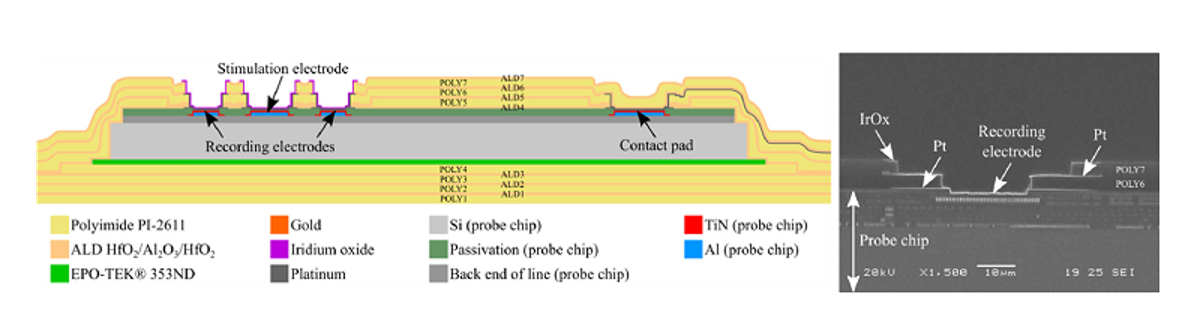 (Left) Schematic cross-section of the encapsulated chip. The alternating polyimide films and ALD layers were etched in different stages, each with an adjusted masking layout, resulting in a stepped profile. This guaranteed that the side walls of the vias are always covered with a bidirectional diffusion barrier. (Right) Scanning electron microscope (SEM) image of a via toward a recording electrode that shows the stepped profile. Source: Imec
Closing the loop
Most implants are still feed-forward: you switch the device on/off, stimulation starts/stops. The physician can toggle the intensity of the stimulation, and that’s it. One example is the device Imec developed with its partner Neurogyn, for stimulation of the pelvic nerve, which runs through the area around the bladder and the genitals. Stimulation calms an overactive bladder in patients with irritable bladder syndrome, but it also helps with conditions such as incontinence and certain sexual disorders. The resulting prototype is currently in the preclinical phase of medical device development. The future, however, lies in a closed-loop system in which stimulation occurs based on measured parameters.
That’s the idea behind the project NerveRepack for Horizon Europe, where Imec and the consortium it is part of have recently started working on an implant for an amputee’s hand stub that reads out and stimulates the arm nerve in order to move an artificial hand. For such a design, Imec will draw on its expertise in signal acquisition, processing and stimulation, as well as on its experience in miniature, low-power designs with edge computing.
To target the right nerve, the devices have to be placed very close to the surface, for example, as a cuff or inside the nerve. These spatial constraints, in turn, limit the volume and energy of the device. The nerve implant ideally has a millimeter-scale volume and — since there’s no room for a battery — the electronic system should consume low power (well below 100 µW), to enable wireless power transfer.
On the other hand, nerve signals (called spikes or action potentials) are typically sparse but very fast events (milliseconds), so a high temporal resolution of the recording system is essential. If these signals were sampled with conventional high sampling rates, there would be a high signal redundancy and thus a poor system efficiency.
The total energy consumption of information processing and transport can be significantly reduced if only the changes (i.e., delta) of the signals are processed.
Imec recently translated this idea into a chip that — instead of continuously processing signals — is only active when an event occurs, for instance, up and down phases of action potentials, thereby creating temporal signatures. Imagine that the transmitted temporal signatures could then be decoded and fed back into the implant stimulator to perform real-time closed-loop neuromodulation. This would significantly reduce control latency and the data rate, thereby reducing the wireless communication requirements as well as the power consumption.
How to power the implant?
With the increasing complexity of the implants, energy-efficient powering is more important than ever. The choice of power source depends on the user scenario and is often a balance between how often the user needs the implant, how much energy it consumes and how life-threatening the condition is it alleviates.
For example, the artificial hand from the EU project mentioned above can be removed while sleeping and charged on a bedside table. In this case, no battery or a very small implantable battery is sufficient. On the other end of the spectrum are implants that stimulate continuously, such as the Neurogyn stimulator for an overactive bladder. These require larger batteries, either rechargeable or replaceable through surgery.
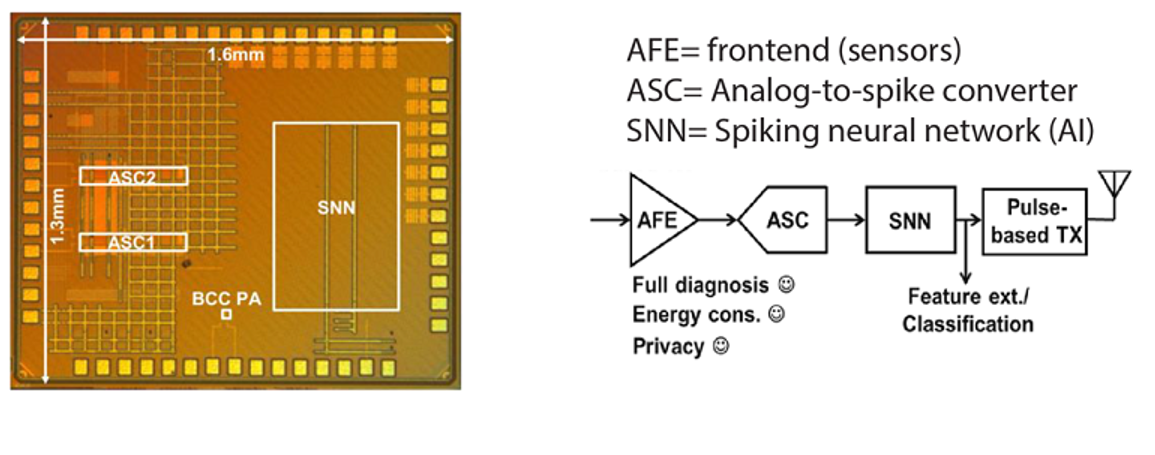 (Left) The chip’s layout and (Right) diagram with a system that compresses data a hundredfold by only transmitting event signatures. The resulting system includes an analog-to-spike converter which reports the events (“delta encoding”) when they cross a threshold, a spiking neural network or AI for local computation and a pulse-based transmitter tailored for low-energy event-driven transmission. Source: Imec
Recently, ultrasound has sparked great interest in the PNS field for the powering of implants. Ultrasound is interesting for biomedical applications because the waves propagate through tissue with little scattering.
Additionally, these waves can be highly focused with beamforming techniques. By manipulating the phase and amplitude of each transducer in an array, the resulting ultrasound beam can be steered electronically without physically moving the transducer. This allows the beam to be directed toward a specific target within the body. These advantages make ultrasound a compelling alternative to inductive powering, which requires close proximity and stable alignment of the source and the implant.
Conclusion
Advancements in bioelectronic medicine, particularly the introduction of i²CS, represent a significant leap forward in the precision and efficacy of peripheral nerve stimulation. By enabling targeted activation of specific nerve fibers, this innovative technique holds the promise of more effective treatments with fewer side effects for a range of chronic conditions.
Additionally, ongoing research into advanced packaging for implants, efficient powering solutions and the development of closed-loop systems underscore the multifaceted approach required to bring these technologies to clinical practice.
About the authors
Geert Langereis studied electrical engineering and ergonomics at the University of Twente, Enschede, The Netherlands. He received a Ph.D. degree in lab-on-a-chip technologies from the University of Twente in 1999. From 1999 to 2009, he worked at the industrial research laboratories of Philips and NXP on MEMS silicon technology and photonics in combination with data science. From 2009 to 2020, he was a professor and a coordinator of research lines with the Technical University of Eindhoven, Eindhoven, The Netherlands, and the School for Applied Sciences. This was in smart sensors and associated data science for the measurement of human behavior and physiology. He is currently the program manager for the health research line with Imec, Eindhoven, on neuro and photonic technologies for bioelectronic medicine. He holds a part-time position at the department of electrical engineering of the Technical University of Eindhoven.
Vojkan Mihajlović is a principal member of technical staff at Stichting IMEC Nederland. He received a Ph.D. degree in computer science from the University of Twente in 2002. He has more than 15 years of experience in the domain of neuromodulation technologies and applications. The first five years include experience within Philips Research (2008 to 2012), where he focused on algorithms and methods for improving signal integrity in EEG recordings. He has been leading the Wearable Brain Monitoring work package at Stichting IMEC Nederland (2016 to 2021), after which he fused on the creation of a roadmap on the selective peripheral nerve stimulation and established a research team to explore and develop required technology solutions. He is currently active as a technical lead for neuro applications and coordinates health innovation activities within Stichting IMEC Nederland. He has ample experience in the neuromodulation area, both in terms of technology innovation and applications, but also in coordinating and managing projects, and steering innovation activities in the health domain. He has authored more than 80 peer reviewed publications and holds 15 patents.