Small ‘Scale’ Advance for Medical and Electronics Materials
S. Himmelstein | January 31, 2018Scales serve animals and fish by being flexible, strong and wettable, properties that materials scientists would 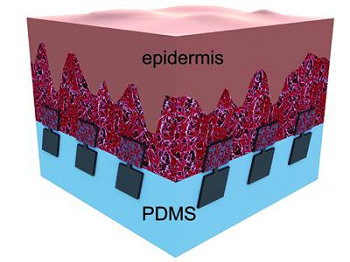 Illustration shows how the "dumbbells," (in grey) hook into the layer of blue silicone on one end and grow into the layer of skin on top, which fixes the implant in place. Source: Tian lab/University of Chicagolike to replicate for medical implant, underwater adhesive and flexible electronics applications. The development of inorganic analogues has proven unsuccessful, until now. University of Chicago researchers combined two biocompatible materials — silicone and calcite — to form scales that can attach to soft materials.
Silicone, a rubbery material widely used in surgical implants, is incapable of immobilizing tissue components. The mineral calcite alone is too stiff, but when combined with silicone results in a strong, flexible structure for adhesion to biological tissue and encapsulation for sensitive components in flexible electronics.
Dumbbell-shaped calcite structures are partially embedded in a silicone matrix. After lab-grown tissue was placed on top, the protruding calcite scales harvested calcium from the cells and grew into the tissue, affixing themselves in place.
Researchers from U.S. Argonne National Laboratory, the University of Science and Technology of China, the University of Southampton in the UK and Hanyang University in South Korea also participated in the investigation.
The research is published in the journal Nature Communications.