A cost-effective replacement for gas peaker plants in Australia
S. Himmelstein | May 02, 2021Battery storage can be a significantly cheaper and more effective technology than natural gas in providing peaking capacity, according to a new study by Australia’s Clean Energy Council.
An analysis comparing a new 250 MW open-cycle gas turbine plant with a 250 MW four-hour grid-scale battery in New South Wales concludes that the battery provides cost savings of more than 30% while offering greater flexibility and significantly reducing emissions intensity. Both two-hour and four-hour battery storage solutions are more cost-competitive than a conventional open-cycle gas turbine peaker – outperforming it in terms of both levelized cost of capacity and levelized cost of energy.
Projections indicate that between 6 GW and 19 GW of new dispatchable resources will be needed across Australia’s National Electricity Market by 2040. Batteries are now the most prudent choice to meet this level of dispatchable capacity, a fact reflected in the market by both real projects and an estimated $6 billion investment pipeline.
Since 2018, 8.9 GW of large-scale battery storage has been financially committed, proposed or approved in Australia. This represents 42,000 construction and installation jobs and 11,000 ongoing operations and maintenance jobs. This momentum is evident in the 15 large-scale battery storage projects announced in 2021, representing 6.6 GW of capacity and $4.3 billion in investment.
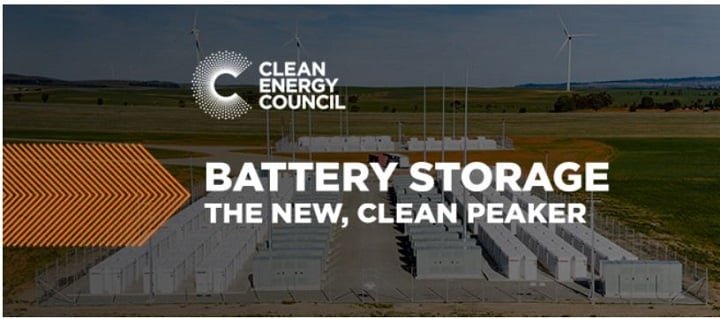 Source: Clean Energy Council