
Massive solar plus storage project cleared a hurdle
David Wagman | September 11, 2019The Los Angeles Department of Water and Power (LADWP) Board of Commission voted to approve power purchase agreements for the Eland Solar and Storage Center. If built, the project would rank among the largest solar and battery energy storage systems in the United States. The agreements are subject to City Council approval.
The facility would cover roughly 2,650 acres in Kern County, and include two solar facilities with a combined 400 megawatts (MW) of generating capacity and store up to 1,200 megawatt-hours (MWh) of energy.
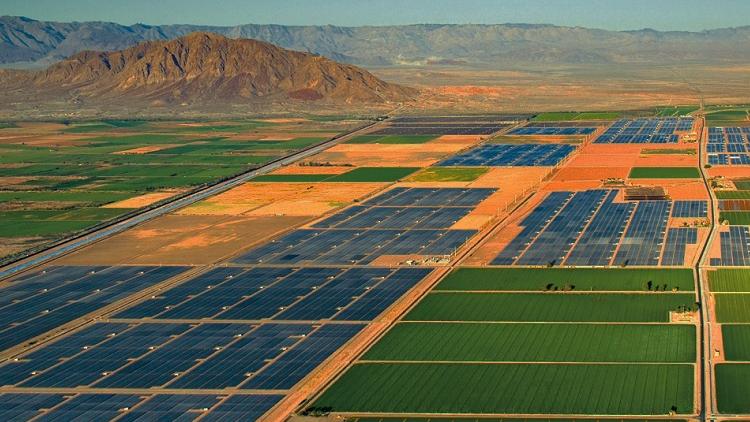 The 260 MW Mount Signal One solar project in California generates energy for San Diego Gas & Electric.. Source: 8MinuteEnergyLADWP approved two power purchase agreements with developer 8Minutenergy to develop the project and begin commercial operation no later than Dec. 31, 2023. The Eland proposal would be built in two phases and includes a fixed cost reported by LADWP to be less than 2 cents per kilowatt-hour (kWh) for solar power. 8Minutenergy would be responsible for costs associated with the facility's development, maintenance and operation. The combined price to ratepayers for the solar and storage would be around 3.3 cents per kWh.
The project is expected to employ 40 operations and maintenance staff when it enters service.
Labor agreement hiccup
Labor issues cast a shadow over the proposed project. Local news reports said that International Brotherhood of Electrical Workers Local 18, which represents utility employees, objected to LADWP plans to scrap three gas-fired power plants which employ around 400 people. City officials said that no jobs would be lost, but union members remained skeptical. A September 10 press release announcing the project's approval included word that 8Minutenergy had signed a labor agreement with local labor unions of Kern County.
The Eland project would be LADWP’s first utility-scale, integrated solar and battery project designed to provide fully dispatchable power to customers in the evening and nighttime hours.
Nearby Glendale Water and Power would receive a 12.5% share of the total solar and battery storage and the contracts would be administered through the Southern California Public Power Authority (SCPPA).
Power and energy capacities
When discussing battery storage, one important distinction is the difference between power and energy capacity. Conventional generation technologies are often defined in terms of power capacity, which is the maximum instantaneous amount of power output, and is measured in units such as megawatts.
However, batteries are limited by the time they can sustain power output before they need to recharge. The duration is the length of time that a storage system can sustain power output at its maximum discharge rate, typically expressed in hours. The energy capacity of the battery storage system is the total amount of energy that can be stored or discharged by the battery storage system and is measured in units such as megawatthours.
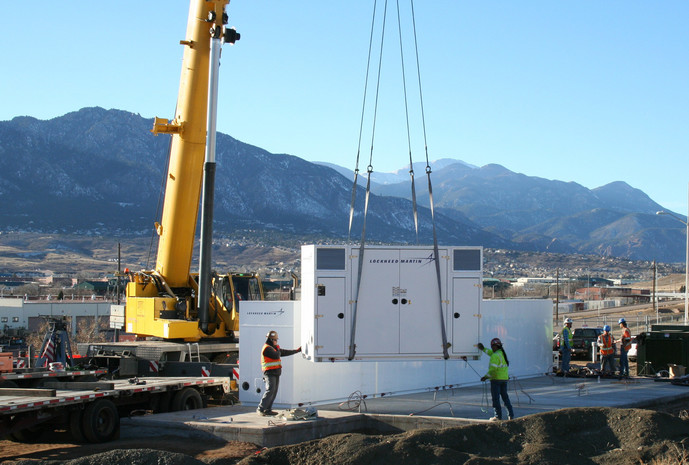 Workers install portions of a battery storage system at Fort Carson, Colo. Credit: Scott Clark, USACEA 2018 report by the Energy Department's Energy Information Administration (EIA) said that battery storage installations in the California Independent System Operator (CAISO) region accounted for 18% of existing U.S. large-scale battery storage power capacity and 44% of existing energy capacity in 2017. Of the state's power capacity, around two-thirds were procured by Southern California Edison and San Diego Gas and Electric to help address reliability risks as a result of constraints on the natural gas supply following a leak at a major natural gas storage facility in the region.
The California Public Utilities Commission requires generation resources to provide at least four hours of output to contribute to reliability reserves. As a result, large-scale battery storage installations in the state tend to need larger energy capacities to qualify as reliability resources.
EIA said that given the trend of using battery storage for applications such as reliability, large-scale battery storage installations in California tend to be energy-oriented with small power capacities and long durations. Large-scale battery storage installations in CAISO have an average power capacity of 5 MW and an average duration of 4 hours, EIA said.
By contrast, installations in the PJM region, which includes load centers from Illinois to New Jersey, tend to be power-oriented. EIA said this means storage installations have larger capacities and shorter durations to serve frequency regulation applications. Large-scale battery storage installations in PJM have an average power capacity of 12 MW and an average duration of less than 45 minutes.
8minute in 1 minute
8Minute was founded in 2009 by Martin Hermann and Tom Buttgenbach. In December 2018, Buttgenbach and the 8Minute management team bought Hermann’s shares in 8Minute and took full ownership control of the company. Hermann gave up his role as CEO and shareholder and Buttgenbach took on the dual roles of president and CEO.
J.P. Morgan Asset Management and an affiliate of Upper Bay Infrastructure Partners teamed up to provide equity capital to support 8Minute’s reported 10.7 gigawatt pipeline of utility solar and storage projects. The joint venture, along with investment from Buttgenbach, provides more than $200 million in capital commitments.
In July, NV Energy and the Moapa Band of Paiutes tapped 8Minute to develop the Southern Bighorn Solar & Storage Center in Nevada. That project will include a 475 MW-dc (300 MW-ac) solar array with 540 MWh of lithium-ion battery energy storage. It will be built on the Moapa River Indian Reservation about 30 miles north of Las Vegas, and will be the largest solar plus storage center in Nevada.



Did somebody clever check their numbers?
They want to replace 3 gas fired power plants but they do not say what nameplate these have.
It should not be more than the 400 MW of the solar, but given the storage and thinking of 12 hours no sun it seems they could not even replace one gas fired power plant with a nameplate of 100 MW.