Watch how AI, microfluidics combine to detect vascular diseases
S. Himmelstein | April 28, 2021An artificial intelligence (AI) platform developed to assess blood flow characteristics through microvasculature could help clinicians in the diagnosis and monitoring of vascular diseases.
The system designed by researchers from Brown University, MIT and Nanyang Technological University 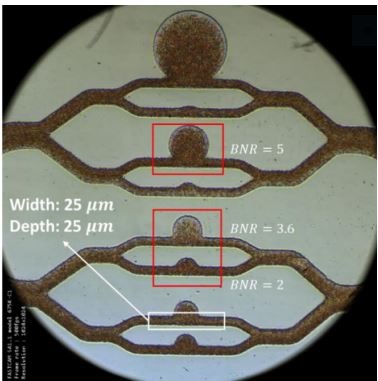 A microscopic image of the microaneurysm-on-a-chip. Source: Subra Suresh et al.Singapore combines machine learning and a specially designed microfluidic chip with analysis of 2D video images of blood flow to infer how blood flows in 3D. The ability to accurately determine flow characteristics is crucial for monitoring the progression of vascular diseases. Abnormalities revealed by the AI system, such as an abrupt change in speed or shear stress of blood flow, could signal the presence of disease.
The platform was tested on simulated microaneurysms of the eye as represented with the microfluidic chip. Microaneurysms are bulges in micro-scale blood vessels of a diabetic patient’s eye and emerge as an early sign of diabetic retinopathy. After analysis of blood flow images from the chip, the AI system successfully predicted blood circulation characteristics within the device.
A paper on this research is published in the Proceedings of the National Academy of Sciences.