Drug testing with a blood-brain barrier on a chip
S. Himmelstein | July 20, 2021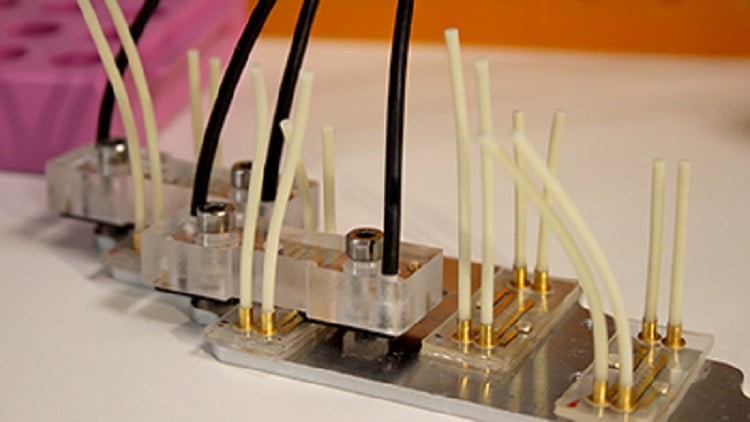 Close-up look at the brain-on-chip model. Source: Saskia Ludwig/ KTH Royal Institute of Technology
A tool devised by researchers in Sweden can advance the study of pharmaceutical compound interaction with the blood-brain barrier without the need to rely on laboratory animal models. The blood-brain barrier on a chip incorporates human-derived stem cells and sensors to monitor barrier function in near real time.
Small channels in the two layered set-up carry simulated blood and inflammation agents, as well as anti-inflammatory drugs, through compartments simulating the perivascular space within the brain, and the external vascular system. Just as in a real brain, these two areas are separated by a membrane of stem cells knitted together with proteins. Cell activity is monitored by electronic sensors that record measurements every minute as the barrier is exposed to stress similar to that associated with neurodegenerative diseases.
A proof of concept study conducted by researchers from KTH Royal Institute of Technology and the Karolinska Institute detailed how the blood-brain barrier reacts to high levels of inflammation after the administration of a next-generation derivative of the widely used anti-inflammatory drug, N-acetylcysteine (NAC). The results, published in the journal Small, indicate that the system can be of value in evaluating other derivatives of the NAC compound and different antioxidants.